Featured

Harry James Ingold

The long lost brother of Walter (George) Ingold

b. Sept19.1879 Edgware UK d. Aug14.1945 East London South Africa,

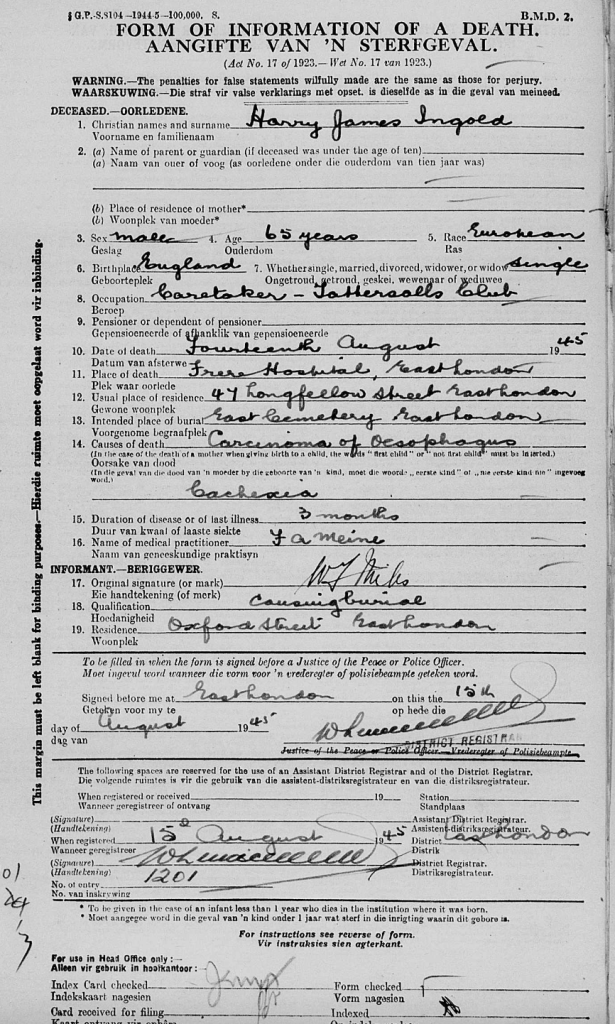
On August 14, 1945, Harry James Ingold died alone at Frere Hospital in East London, East Cape, South Africa. The cause of death was “carcinoma of the esophagus”, and “cachexia” – a kind of anorexia related to cancer. He was 65 years old. Occupation: “Caretaker at Tattersalls Club”.

The only thing my father knew about his Uncle Harry James Ingold was “he went to South Africa to look for diamonds and the family never heard from him again”. 

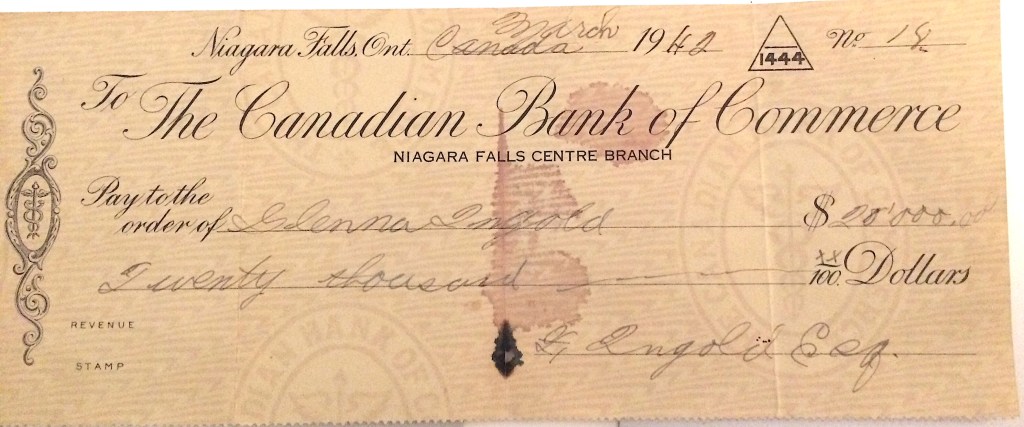
In 2017 we found an interesting item in my late Aunt Glenna’s belongings: an uncashed cheque payable to her for $20,000 dated March, 1942, signed by “H. Ingold, Esq”.  It was drawn on my grandfather’s George’s local bank account, but surely he was pranking his kids with tales of a rich uncle in South Africa.
It got me wondering what actually became of Harry after he went to East Cape.

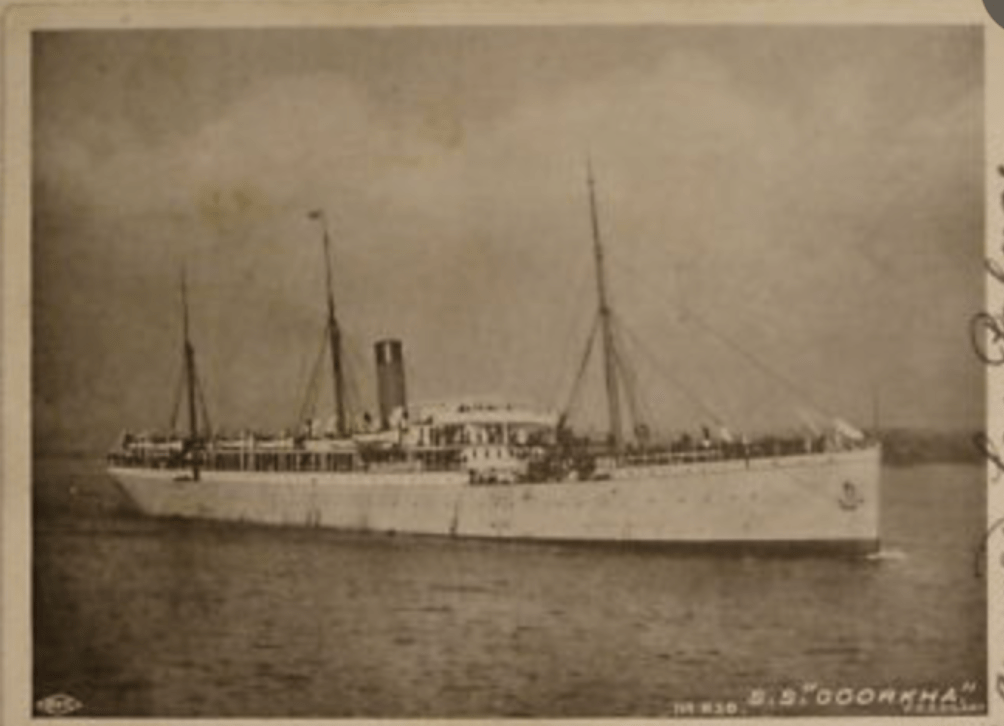
Below: The Steamship Goorkha
Below: Harry Ingold’s manifest entry. The voyage took 42 days!

 

The Kimberley Mine, Northern Cape, South Africa

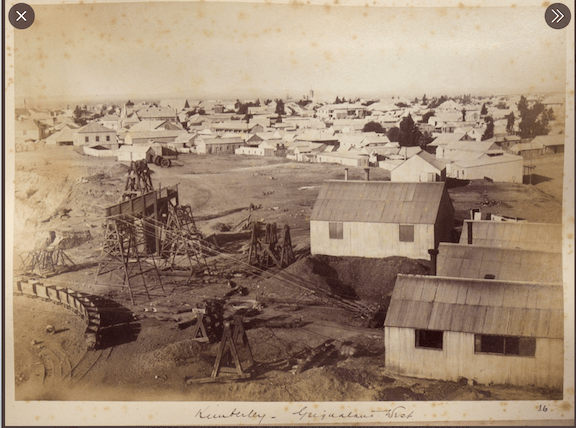
If Harry actually arrived at or worked as a miner at Kimberley, it’s certain he didn’t stay long. An egregious example of colonialism, the Kimberley Mine was rampant with disease and violence. The abuse of black workers was horrific. Only the De Beers family profited, otherwise it was a place to die. Kimberley even had it’s own cemetery.

Below: Kimberley Mine, 1900
 

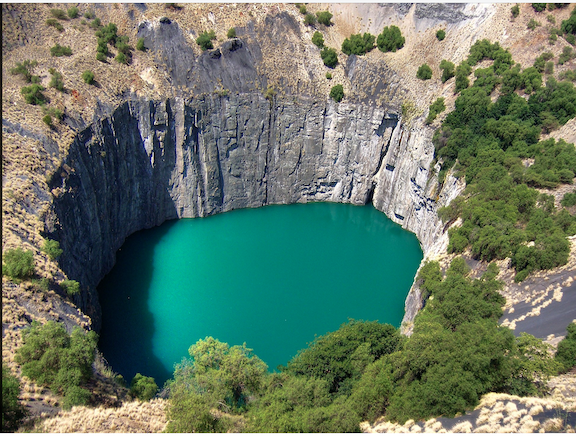
Below: Kimberley Mine today – one of South Africa’s top tourist attractions
 

Cape Town and Service in The Boer War – 1901

In 1901 Harry was living in Observatory, a suburb of Cape Town. He lived on Station Road in Albany Park.

Below: Station Road, 1901

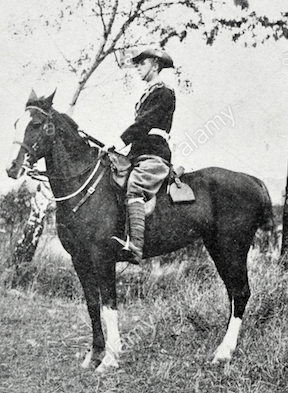
On January 19, 1901, he walked into Drill Hall at Cape Town to answer a call for militia men for “Warren’s Mounted Infantry”. His attestation lists his occupation as “horse trainer”. He was unmarried at the time, naming his next of kin as his eldest sister, Bertha Maud Ingold. 
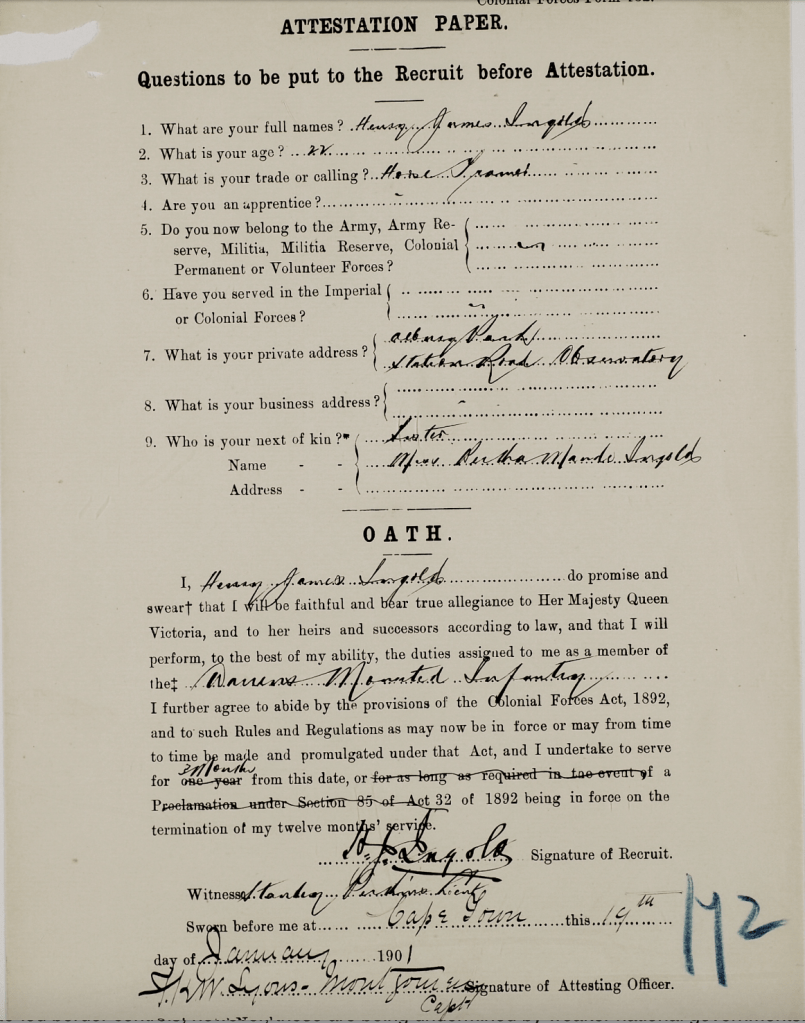
Warren’s Mounted Infantry played an unremarkable role in the Boer War. Harry served as a Trooper from April to August of 1901.

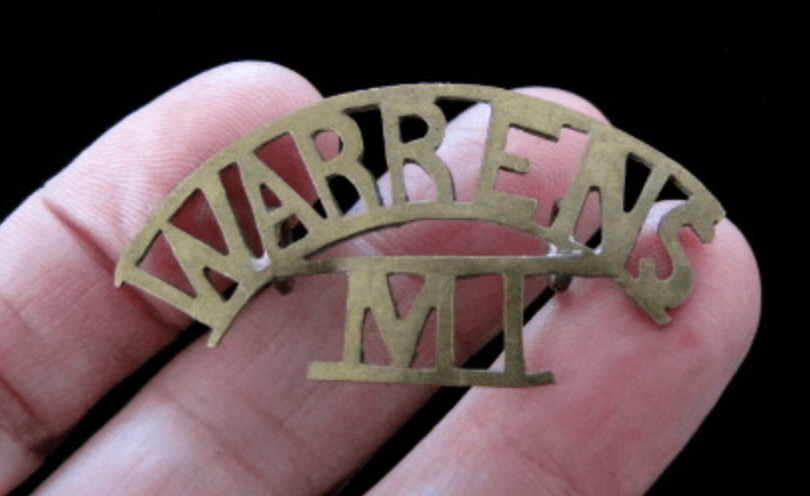
Below: Standard Kit for Mounted Infantry and Warren’s Mounted Infantry Uniform Badge
 

Later Life 

The lack of access to South African records makes it difficult to trace Harry’s further life in South Africa. After 1902, there is a 40 year gap in my research except for a few snippets:

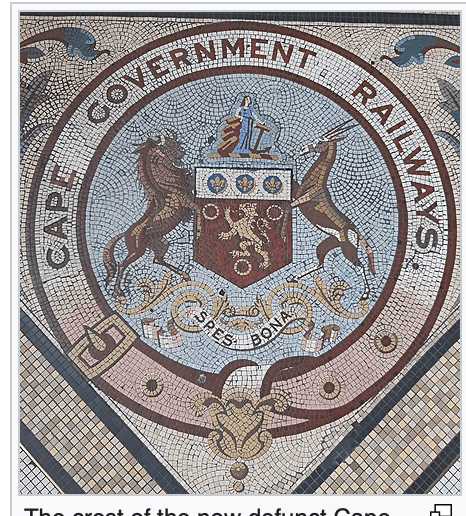
  • The 1906 Red Book South African city directory lists Harry as living in a suburb of East London, Eastern Cape and working as a clerk for the Cape Government Railway at Komgha Station. 
  • On December 8, 1908 Charley Ingold, Harry’s youngest brother placed an ad in the London Echo. Charley was about to depart from England to South Africa as a Private with the 7th Hussars. I don’t know if the two ever connected again. Aside from getting the year wrong, Charley placed his ad in a show business newspaper….Charley is another story.

  • On January 31, 1939, Harry James Ingold claims his Boer War Victory Medal 38 years after his service.

  • On September 7, 2020, this death record popped up for me on FamilySearch.org Discoveries like this make many hours of tedious research worthwhile. There is no official record of a burial or tombstone.
Below: Harry James Ingold’s last known address: 47 Longfellow Street, East London, SA. Note the bars on the windows and doors. South Africa is a dangerous place.

Below: East London is a tourist town today…

Marriage

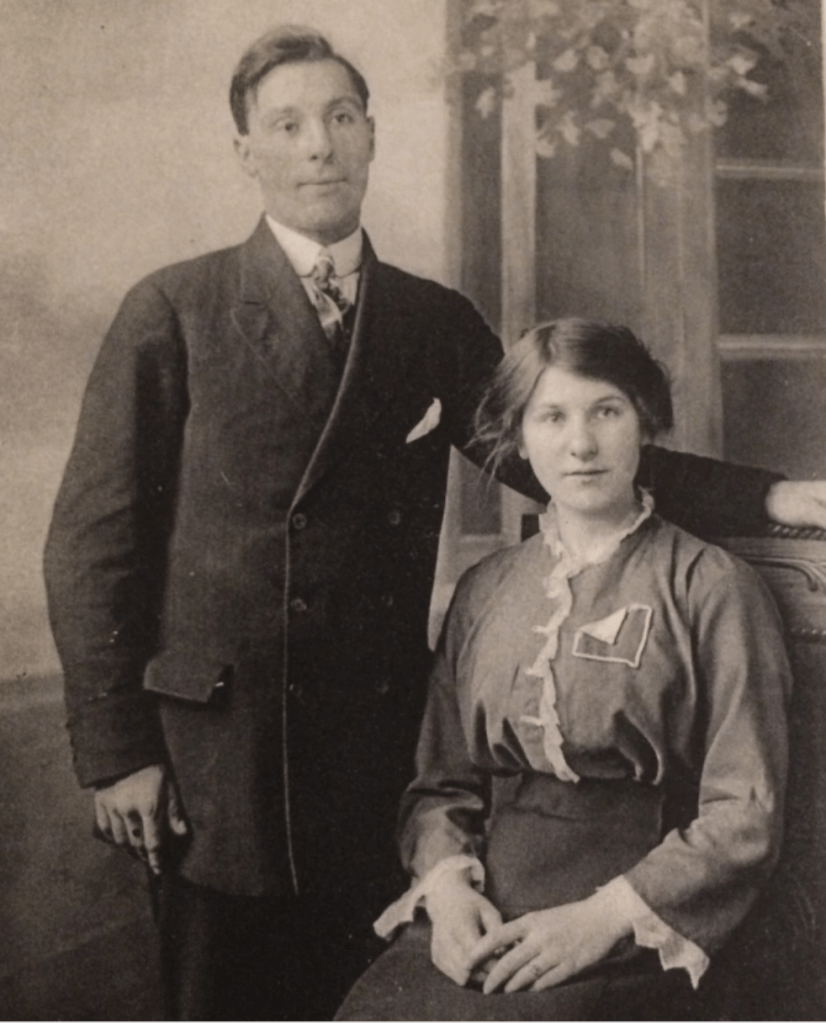
This photo was identified by a Puddifant cousin as Harry James Ingold. The lady in the photo is wearing a wedding ring, but every document in Harry’s name identifies him as single. There is a possibility the lady might be one of George’s sisters, Esther or Lilian, as they both married businessmen. That said, she does not look like an Ingold. For now, I will say this is not Harry James Ingold.

Below: Allegedly Harry James Ingold and alleged wife c. 1910.
 

Late Life: “Caretaker at Tattersalls”

Since the 18th Century, Tattersalls has bred and auctioned race horses, as well as sponsoring prestigious races all around the world. In Harry’s time, Tattersalls operated a chain of betting shops throughout the country.

Below: Tattersalls Betting Shop in Johannesburg
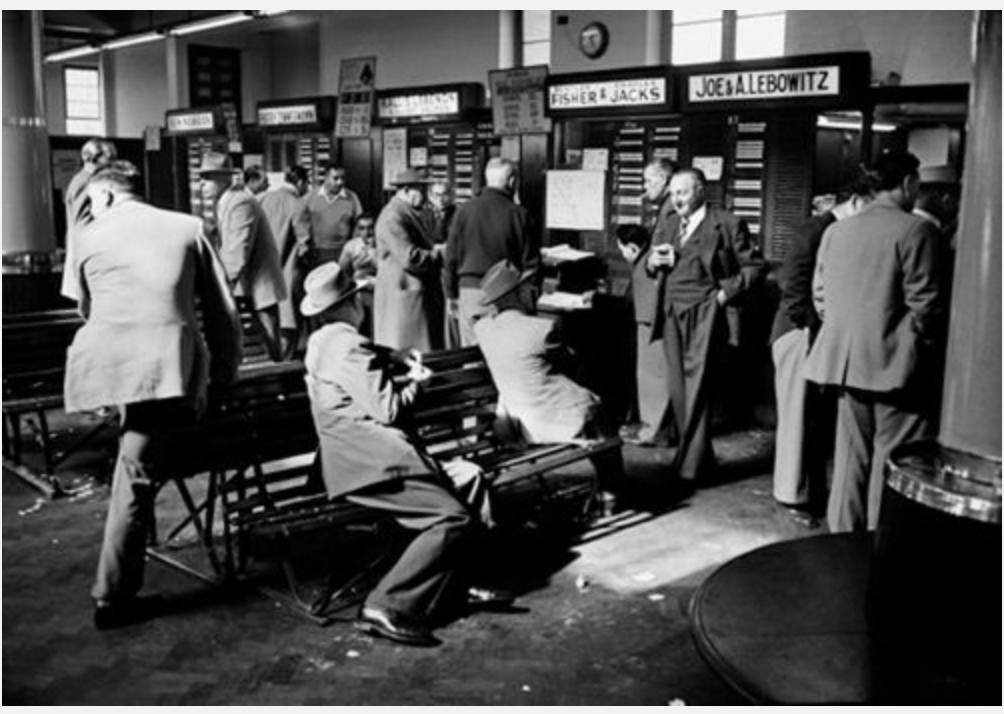
I hoped for a better ending for Harry James Ingold, but his is a sad tale in the Ingold family: a young man with high hopes makes his way in a faraway land, but at the end of his life he’s sweeping floors and emptying ash trays in a bookie joint.

He should have stayed in England.


Featured

52 Weeks of Ancestors – Week 7 – “Landed” 

Grand Aunt Maggie Ingold and the Long Grove Asylum
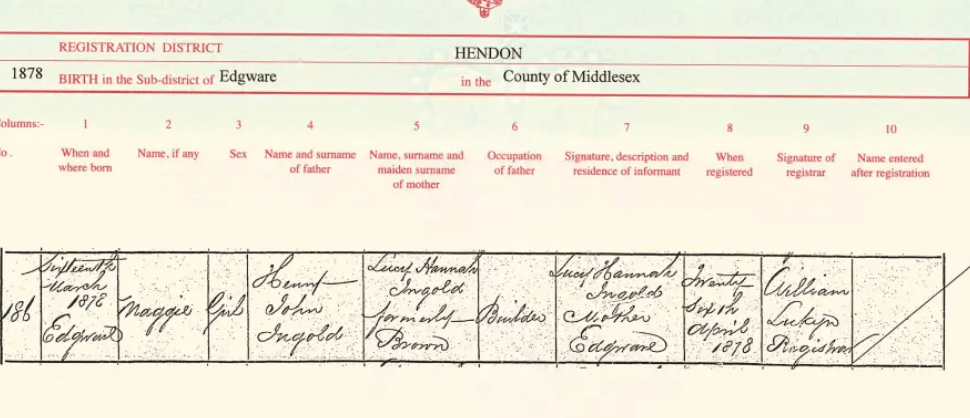
Recently I broke through the final “brick wall” in my family tree. What ever happened to my Grandfather George’s spinster sister..?
Maggie was born on March 16, 1878 making her 6 years older than George. She appears in both the 1881 and 1891 censuses as a daughter living with the family in Edgware.
By age 17, she had lost both parents.
From BritishNewspaperArchive.co.uk I learned she participated in plays and music programs, taught school at age 16 for 4 shillings a week, and was a bridesmaid at her sister Edith’s wedding. 

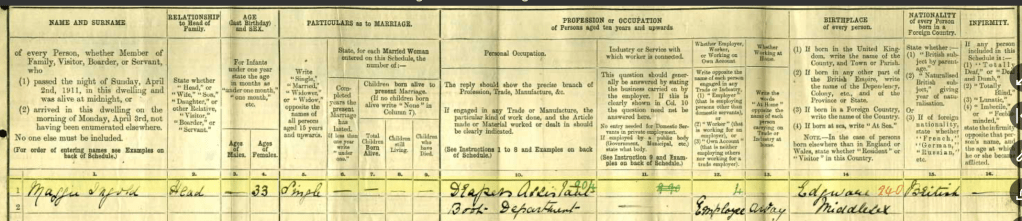
Maggie is missing from the 1901 Census, but in 1911 she is a 33 year old spinster living in 2 rooms in Paddington and working as a Draper’s Assistant (Shopgirl).
After 1911, nothing – no records whatsoever in regard to Maggie – no directory entries, no voting records, no travel, no workhouse and most importantly, no death record. In 2016 I realized I would have to wait 6 years for the 1921 UK census. It was a long 6 years.
In the meantime, I developed some wild theories about what happened to her: perhaps she was one of the victims of the great 1911 heatwave in England, or succumbed to the Spanish Flu around 1918. I also clung to my father’s anecdote that one of his aunts had drowned in Lake Winnipeg (now debunked). 
Imagine my disappointment when, after 6 years of waiting for the release of the UK 1921 census in January 2022, Maggie was not there! How does someone just disappear? It was as if she didn’t want to be found, even in death.
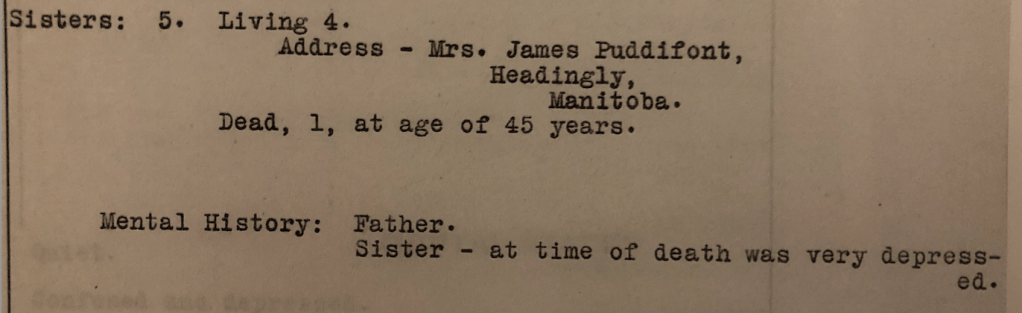
It was when I came into possession of my grand uncle Frank’s asylum records that I learned solid information about Maggie. Frank’s patient record notes the family history of melancholia, citing his father’s suicide and a sister who suffered from depression and died at age 45. Since I knew the death dates for all the Ingold siblings, this “sister” could only be Maggie Ingold, who would have been 45 in 1923.

I now had the approximate year of her death thanks to Frank’s records. So, I went back to the 1921 UK census and found an interesting entry contained on a patient register from Long Grove Mental Hospital, Epsom, Surrey: “Freda Ingold, age 43, born in Edgware, single, a draper’s assistant”, the identical information as in Maggie’s 1911 census form save for the given name. I had finally found my grand-aunt.
Sometime after the 1911 census, for whatever reason, Maggie took to calling herself “Freda”. 
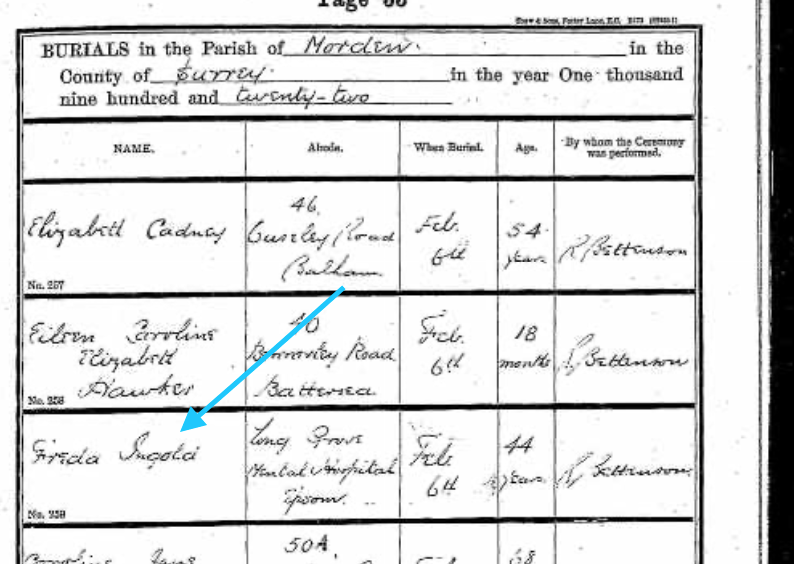
On FindMyPast.co.uk I found a burial record for “Freda” Ingold who died in the Long Grove Mental Hospital in early February, 1922 at age 44 and was buried in a pauper’s grave in Morden, Epsom, Surrey.

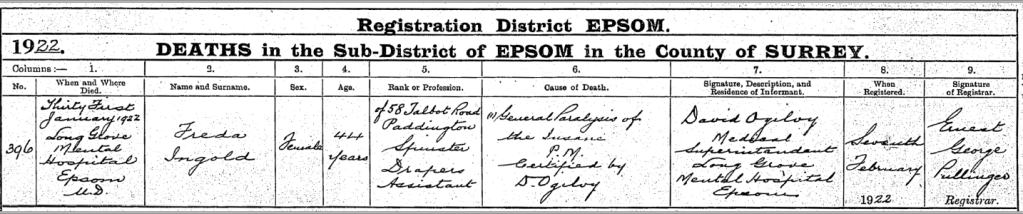
So, why did Maggie Ingold re-name herself as “Freda”? I wondered if she had some sort of dissociative identity disorder, but when I ordered her actual death certificate, the story became clear: Tertiary Syphilis
Cause of Death: “General Paralysis of the Insane” (GPI)- a fatal disease brought on by tertiary syphilis. GPI was more common in male patents and usually appears 10-30 years from the date of infection, meaning Maggie could have been a young teen when she contracted it or as old as 30. 
Symptoms of General Paralysis (Paresis) of the Insane
Delusions can be grandiose, melancholic, or paranoid including ideas of great wealth, immortality, thousands of lovers, unfathomable power, apocalypsis, nihilism, self-guilt, self-blame, or bizarre hypochondriacal complaints. Later, the patient experiences  jerks, confusion, seizures and severe muscular deterioration. Eventually, the paretic dies bedridden, cachectic and completely disoriented.
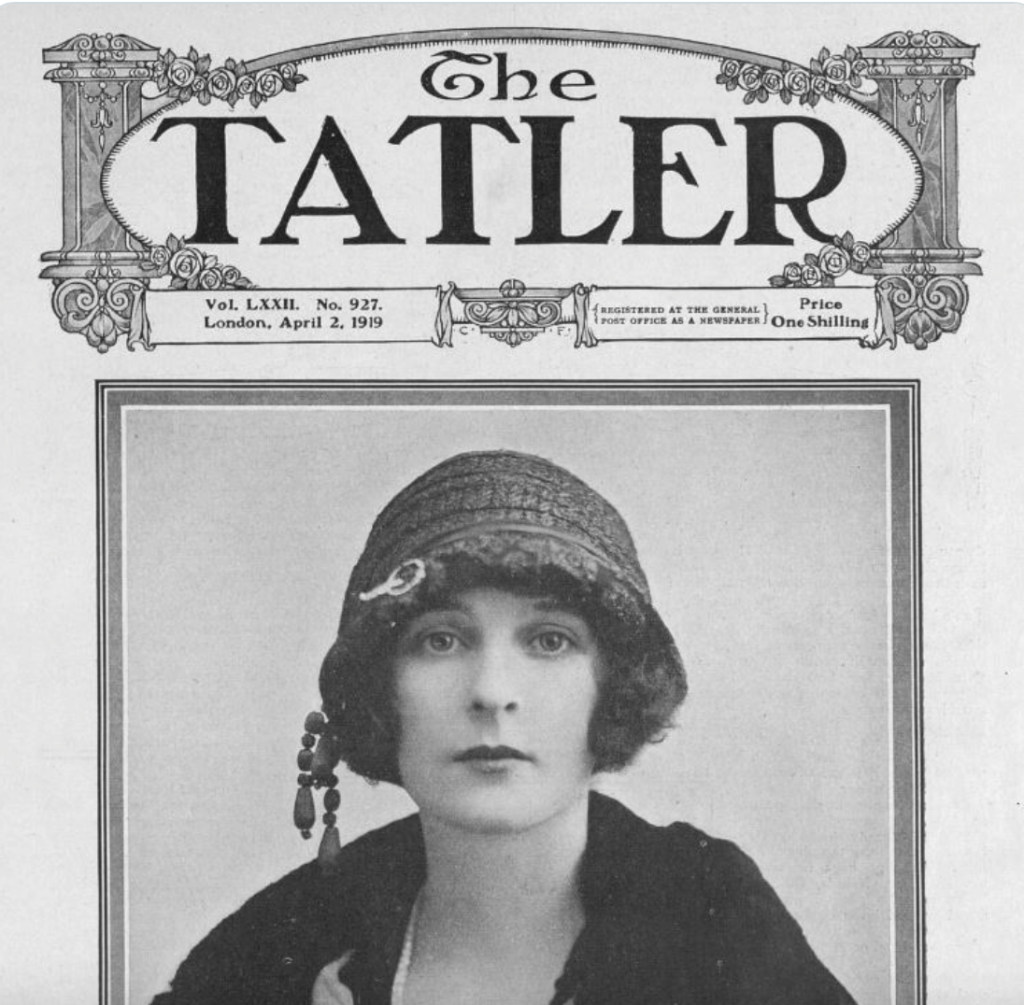
Freda Dudley Ward on the cover of “Tatler”, April 1919
It’s entirely possible that “delusions of grandeur” were a symptom of her condition and she fancied herself a celebrity. 

Tales From The Tree

Angelina Walker

Our Grandmother Was A Bigamist

On May 7, 1917, my grandmother safely crossed the border into Canada at Emerson, Manitoba with $25 dollars on her person. She was listed on the manifest as “Mrs. E.G. Folsom”. It was likely the last time she would go by that name. She had left her American husband in Fairmont, West Virginia and was returning to her previous life in Winnipeg, as a single woman named Lina Walker (Pronounced “LIE-na”). She was the only woman to cross the border that day.

Below: Canadian Immigration Admissions at Emerson Manitoba, May 7, 1917

Years later, she would confess to my mother: “he was an awful beast, he made me do terrible things”. As kids, we always knew George Ingold was her second husband, that she had never divorced Edward Folsom. She always claimed she didn’t know there was any such thing as divorce. We knew that was nonsense: her own sister Lottie had been divorced. 

Let’s go back to the beginning ….

On July 3, 1911, 25-year old Angelina Walker married Dr. Edward Folsom in Toronto. He was a native of Chicago and a recent graduate of the Ontario Veterinarian College. The newlyweds made their home in Fairmont, Virginia where he was employed as a horse doctor at Consolidated Coal Company.

There’s nothing unusual in any of that other than only a few weeks earlier, she had been enumerated in the 1911 Canadian Census as living in Winnipeg at the same rooming house as her sister Ella, and another man who hoped to marry her, our grandfather, Walter George Ingold.

Below: entry from 1911 Census of Winnipeg, taken in June of 1911.

We know Lina and George were a couple at this point, because her sister, Lottie Walker Thompson, announced it in the local newspaper. 

Winnipeg Tribune, July 25, 1910

Whatever possessed Lina to suddenly abandon George Ingold and run off to Toronto to marry Dr. Folsom? 

I have a theory:

In 1910, George Ingold was working as a meat cutter for Wm. Coates Meats. I’m guessing Lina’s siblings, particularly her older brothers in Toronto, didn’t think George was good enough for her.

After all, sister Ella was a nurse, sister Jennie had married a respectable shoe store manager who would eventually own his own shop in Barrie and Lottie married an insurance broker.

Lina herself was a bit of a snob.

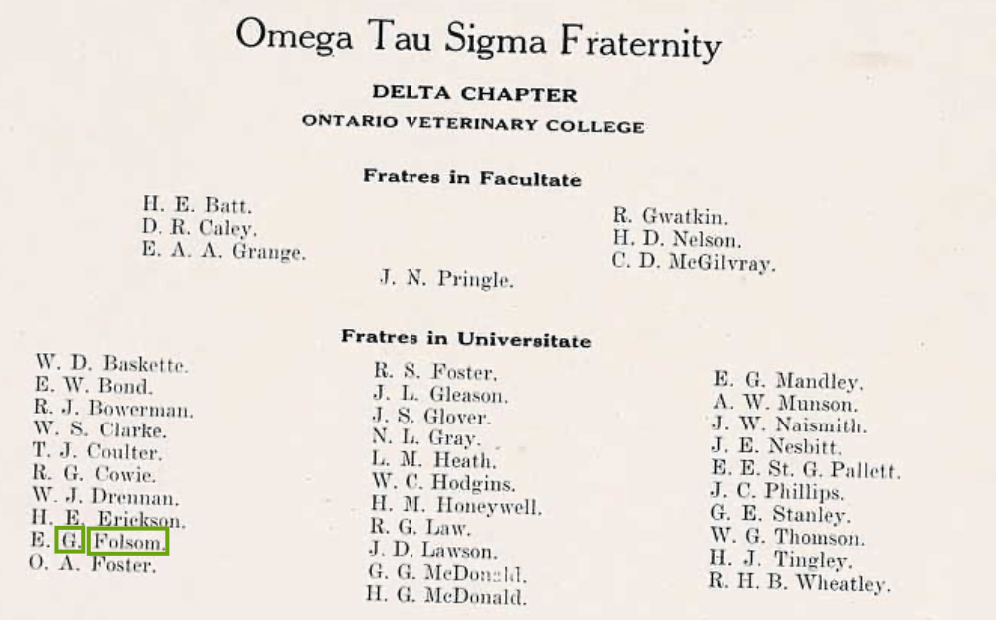
Somehow, on a visit to Toronto, she met Dr. Folsom, recent graduate and a member of an elite University of Toronto fraternity. Lina may very well have been manipulated by her 3 Toronto brothers – Hawley was a successful clothier with his own shop, Chauncey was a manufacturer of farm equipment. A third brother, Frank Walker, a grocery wholesaler, would eventually help George buy into his own grocery business in Niagara Falls in 1923.

I really believe the siblings didn’t want Lina to marry a “meat cutter”.

Below: Dr. Folsom’s University of Toronto fraternity credentials likely knocked the Walkers off their feet.

The marriage certificate offers evidence that could support my theory of family influence.

The ceremony took place in York (east of Toronto) where her brother Chauncey Walker resided. One of the witnesses to the marriage is “Bob Walker”, who lives at 420 Brunswick Avenue in Toronto, which just happens to be the the address of Lina’s brother, George Hawley Walker. Hawley’s fifteen-year son old “Bob Walker” must have gotten a kick out of being a witness to a marriage. Also witnessing the marriage is one of Lina’s and George’s Winnipeg room-mates, Annie Mutch. The cuckolding of George Ingold was complete.

We’ll never know exactly what Lina endured during her 6 year rust-belt marriage to Dr. Folsom but it drove her to an act few women of the time considered. According to my father, Frank Ingold, an unhappy Lina consulted her sisters and they urged her to return to Canada. I like to think she left without Folsom knowing.

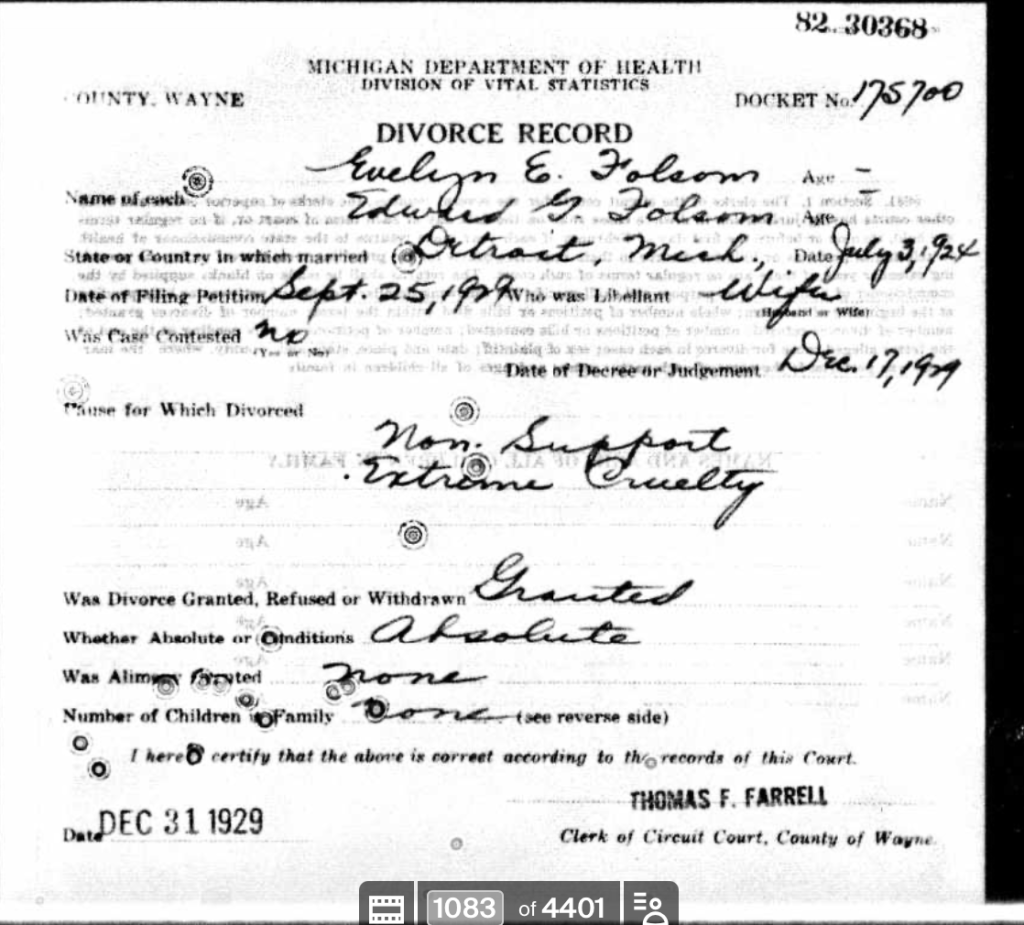
Folsom was the first to commit bigamy: he married Lillian Baker in 1918, then Evelyn Hamilton in 1924. Both women divorced him on the grounds of “extreme cruelty”. No children came from any of his marriages, so there’s that.

Lillian Folsom divorce – 4 years of marriage

Evelyn Folsom divorce – 5 years of marriage

Recently on a genealogy site, I spoke to a descendant by marriage to Dr. Folsom. He confirmed to me that Folsom had been repeatedly whipped behind the woodshed as a child and he learned to “give what he got”. A brother of his was an angry alcoholic.

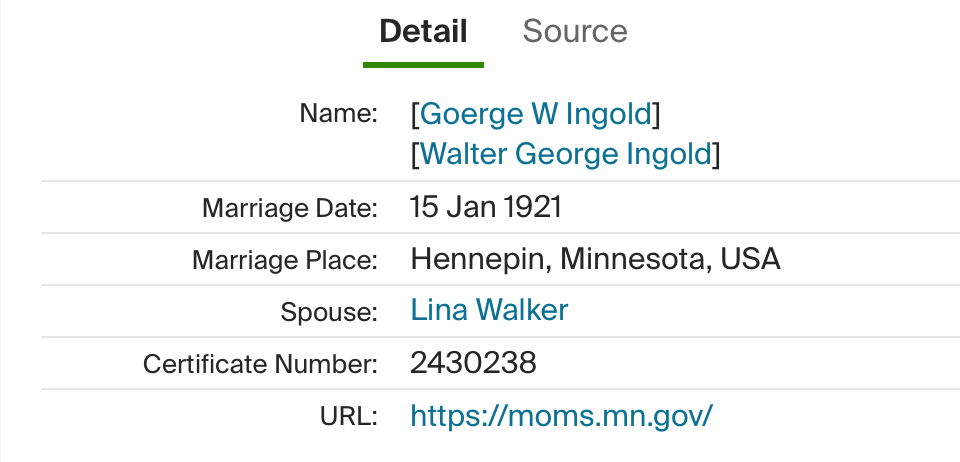
Back in Winnipeg, Lina reunited with George Ingold. In January of 1920 they travelled to Hennepin Country, Minnesota where they were married. Presumably they thought a US marriage would throw a smoke-screen over her Canadian marriage. The nuptials were never valid and she risked 5 years in jail if caught. They spent a few years “on the run” in Regina, Calgary, Vancouver and Toronto before settling down in Niagara Falls, Ontario in 1923.

The date below is incorrect. I’ll have to order the certificate for proof. Either that or Lina was 7 months pregnant with Joyce at the time. Seems unlikely.

When I was younger, I judged Lina as squeamish about marriage and there is plenty of evidence of that, but now, with all the information about Folsom and how he treated his subsequent wives, I sympathize with her. She just wanted to be rid of him, and men held all the cards legally.

Dr. Folsom died in 1930. I remember Lina showing us a news clipping about him, which I now possess. I don’t know where she got it, but she kept it all those years. I wonder why…?

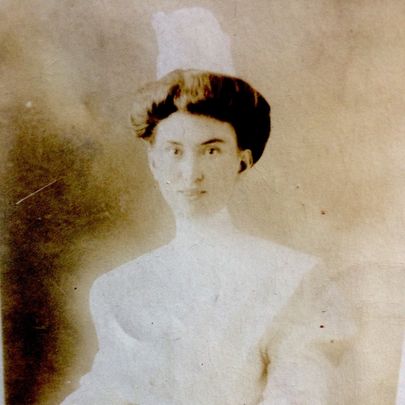
Below: Angelina Walker (1886-1977)

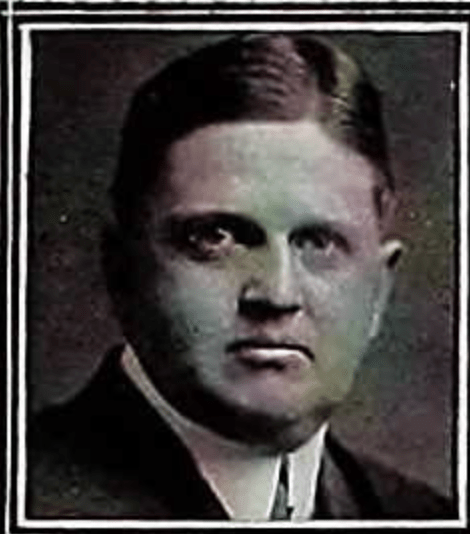
Below: Edward G. Folsom (1886-1930)

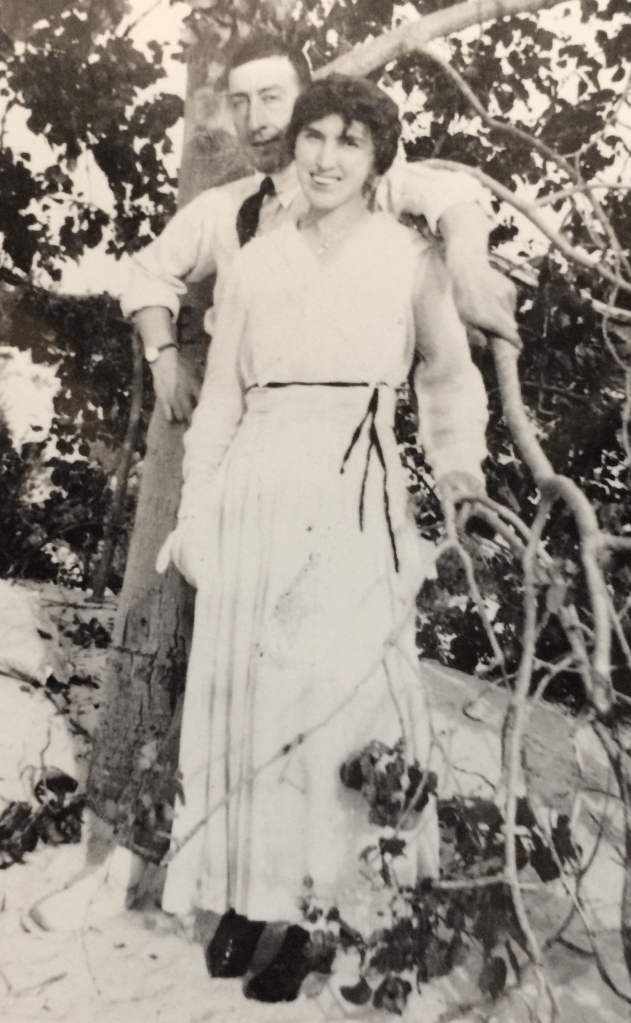
Walter George Ingold (1884-1954) and Lina Walker in Headingly, Manitoba about 1920

Tales From The Tree

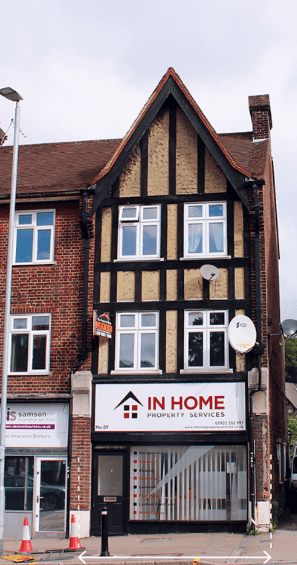
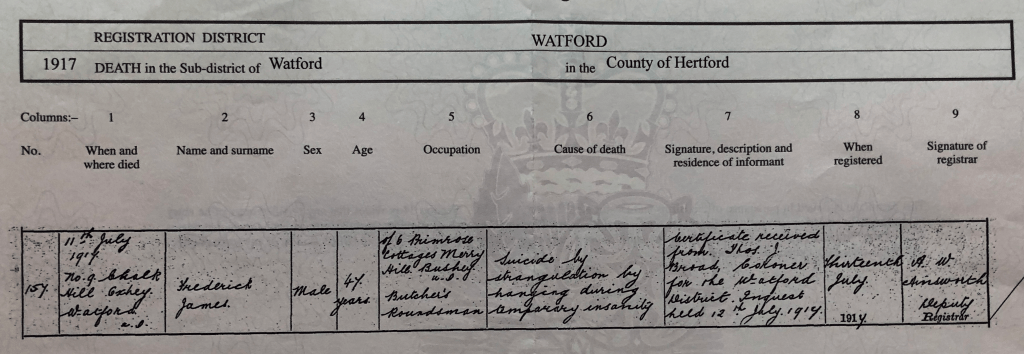
On July 11, 1917, 47-year old Frederick James committed suicide by hanging himself at his workplace, William Barker’s butcher shop. He left behind his widow, Bertha Maud Ingold, 6 children and a history of professional failures.

Below: 9 Chalk Hill, Bushey, UK where Fred James hung himself

Tragically, it wasn’t the first time Bertha had suffered the suicide of a loved one.

Twenty-two years earlier her father, Henry John Ingold drowned himself in an Edgware pond. Henry had been suffering from melancholia since the death of his wife and wrongly believed his business was failing. His suicide shaped the direction of Bertha’s life.

It was Bertha who found Henry’s suicide note. She was the chief witness at the inquest, and as the eldest child, she had to administer his estate and wind down his building business. At 23, she was already considered a spinster and in addition to weathering the suicide scandal, she had to take on responsibility for 7 younger siblings at home (ages 4-19), one of who was my grandfather, Walter George Ingold.  Sometime between 1895 and the 1901 census, the Ingold family had to give up their home on High Street and scattered. Eventually, the two youngest, Frank Ingold and Charley Ingold, were placed in the London Orphan Asylum and the others were put out to work at 14 years old. As each sibling came of age, Bertha gave them their inheritance from Henry’s estate. Assuming the estate was equally divided among the siblings, each received the equivalent of $15,000 Canadian dollars in today’s currency.

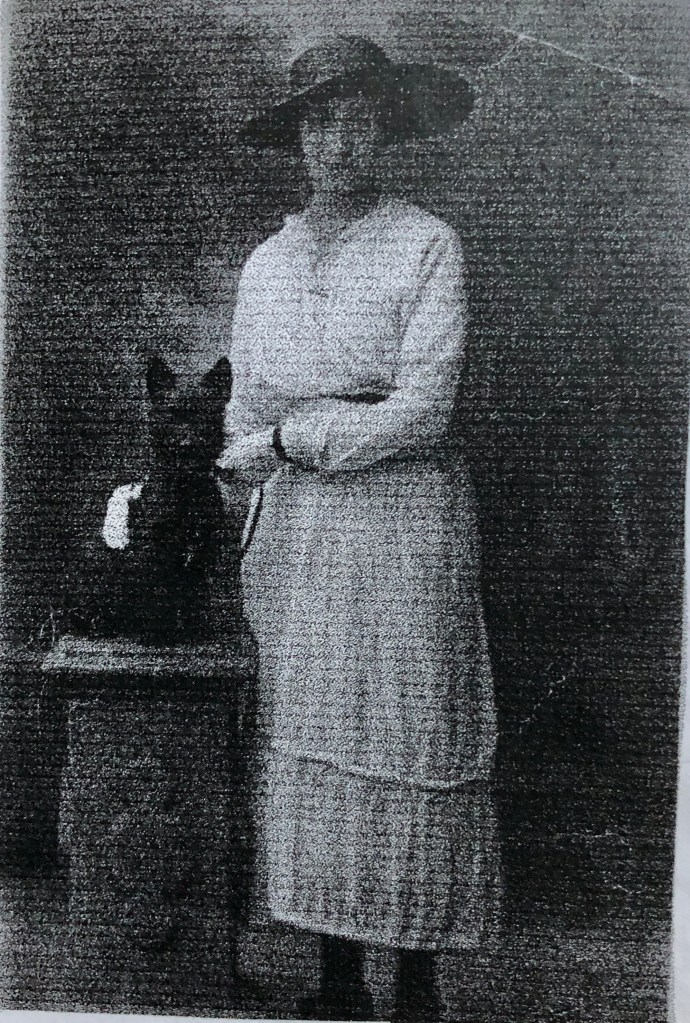
Below: A terrible photocopy of Bertha provided by the Puddifant family. I can see the long, angular face and prominent nose of an Ingold.

A year after Henry’s death, Bertha appears in the 1896 London Trade Directory as a “builder”, reflecting her role in winding down her father’s business…

Beginning in 1901 and by virtue of occupying a house, Bertha becomes the first female Ingold in my family to get the vote. It was only the parochial and county vote, but a milestone for the women in the family

About Frederick James (1869-1917)

Sidenote: A few years ago, I corresponded with Fred and Bertha’s granddaughter. Marg Cortens described him as “a bad businessman who lost all his money”.

The red flags are in the UK census: 

In 1891, Fred was running a shop in Islington, declaring himself a “master butcher” and employing 3 people. At the tender age of 21, he may not have been up to the task.

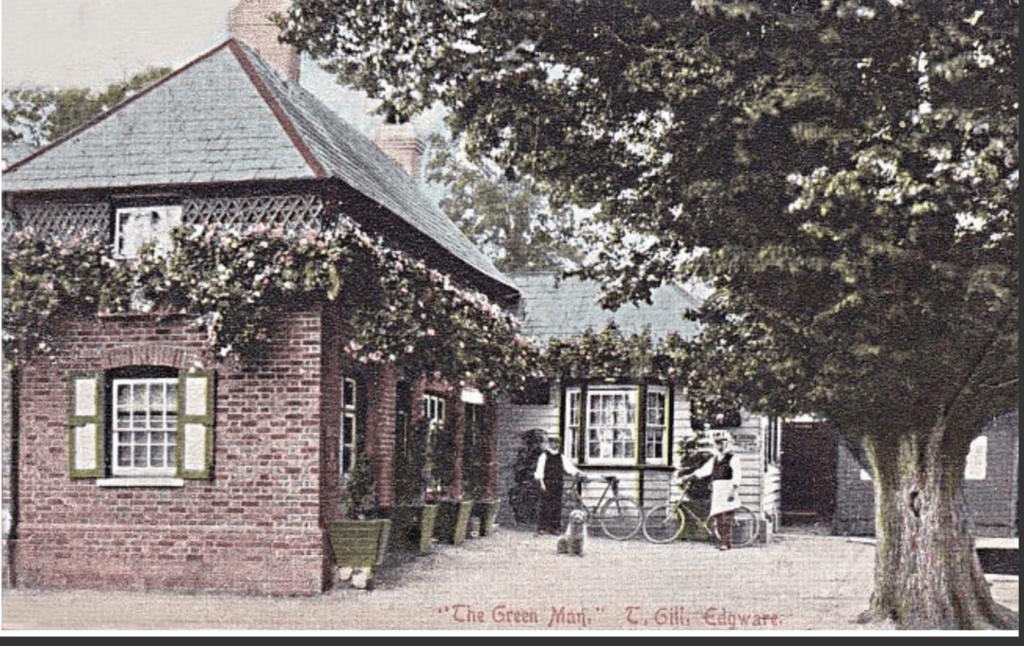
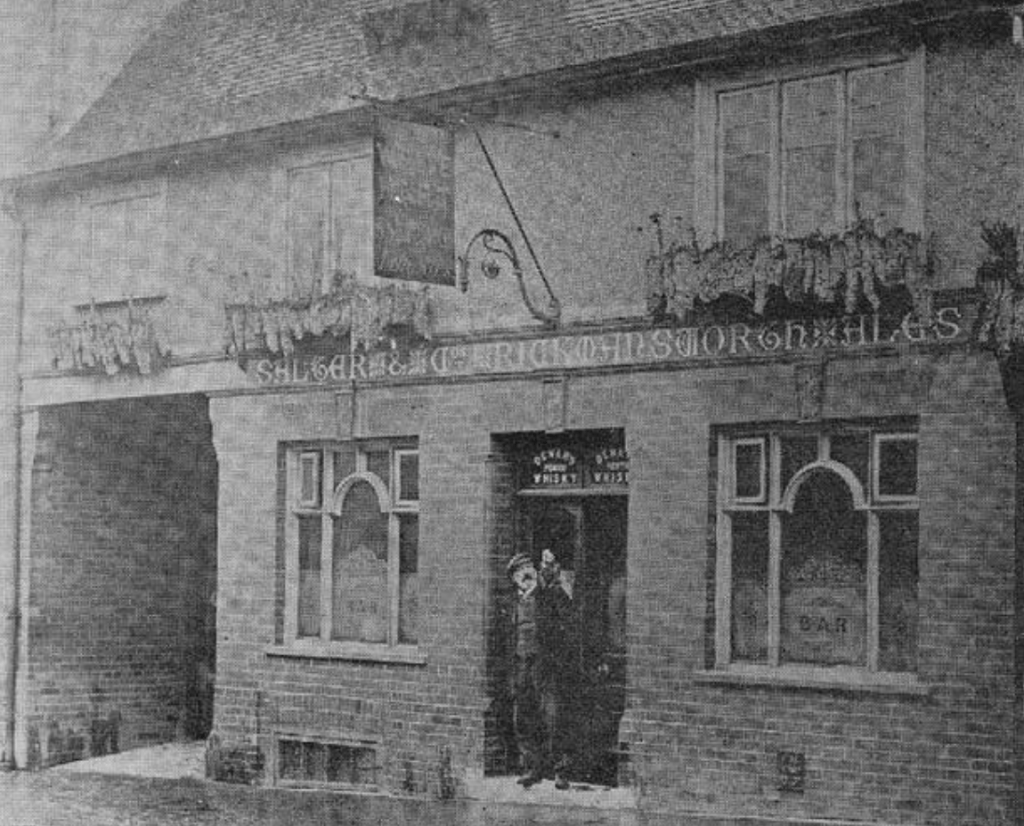
Ten years later Fred is no longer running his own business, but living in a Public House in Edgware and employed as a butcher at the Muddle family’s shop. This is likely around the time he met Bertha Maud Ingold.

Below: The Green Man Pub, home of Fred James in 1901

Fred and Bertha married in October of 1904 around the time her family responsibilities ended. She was 33 and he was 35. Given their daughter Ellen Maud was born the following March, Bertha was likely pregnant at the time of the marriage.

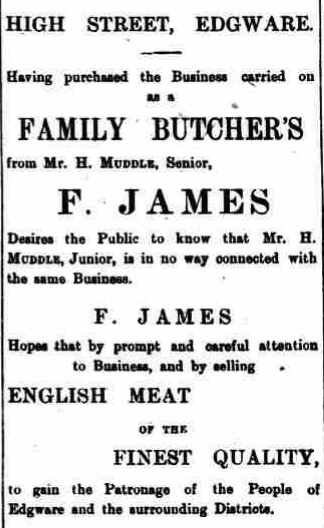
In 1905 Fred bought the Muddle’s shop. He seems to have had some animosity towards the family. Muddle Jr. was reportedly an alcoholic and unpleasant to be around.

Sidenote: my 17 year old grandfather Walter George Ingold was working as a butcher in Edgware according to the 1901 census, and I’ve often wondered if he was employed at the Muddle’s shop.

Fred James failed to make a go of the butcher shop. By 1908, he and Bertha and their growing family were living in Bushey, Hertfordshire where he was employed at “The White Hart”, a public house. Fred took over as landlord in 1911, but that didn’t work out either and he surrendered the license after a year.

Below: The White Hart Public House, Bushey, UK

Below: 1911 Census: Fred is listed as “Licensed Victualler” at “The White Hart. He and Bertha have 4 children at the time.

Who knows what transpired in the years between 1911 up until his suicide in the summer of 1917, but Fred’s death certificate provides a clue: Once a master butcher, he ended his life as a delivery man. (“butcher’s roundsman”).

Below: “Suicide by Strangulation by Hanging”

As for the long-suffering Bertha, she sent her eldest son, 13-year old George to Canada to live and work at his aunt Edith Puddifant’s family farm in Headingly, Manitoba. 

Bertha’s brother, Frank Ingold directed his WW1 army pay to Bertha until he was demobilized. Frank was one of the siblings she shepherded through the London Orphan Asylum. Fifteen years older, she must have seemed like a mother to Frank.

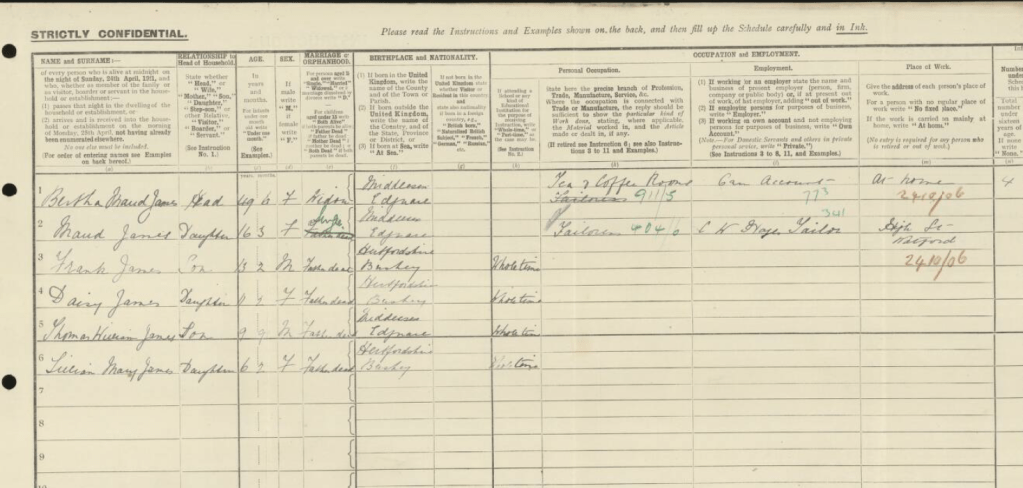
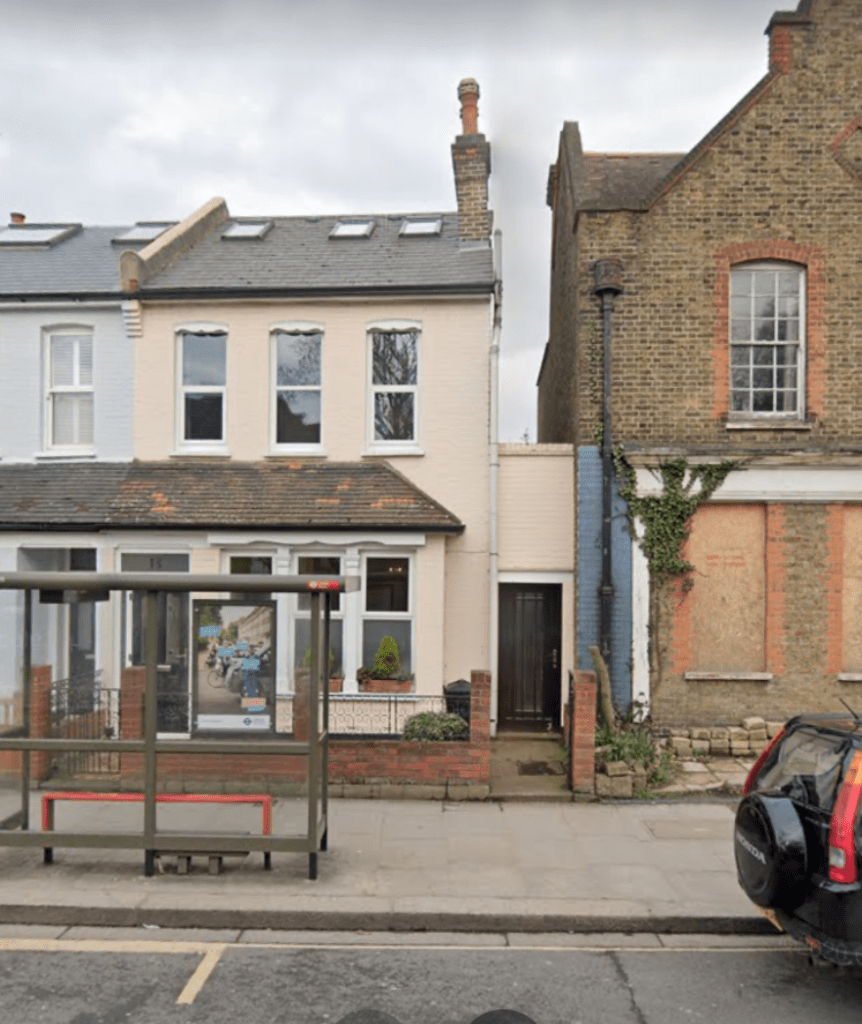
The recent release of the 1921 UK census revealed that Bertha was operating a “tea and coffee room” at 266 High Street, and her 16 year old daughter Maud was contributing to the family by working as a tailor.

Below: 266 High Street, Bushey, Watford, UK

I lost track of the James family after the 1923 directory, but Marg Cortens told me a member of Fred’s family took in Bertha and her remaining children.

In the 1939 UK registry, Bertha was retired and living on Whippendale Road in Watford. Three of her children remained at home and were employed in lucrative war-time jobs. 

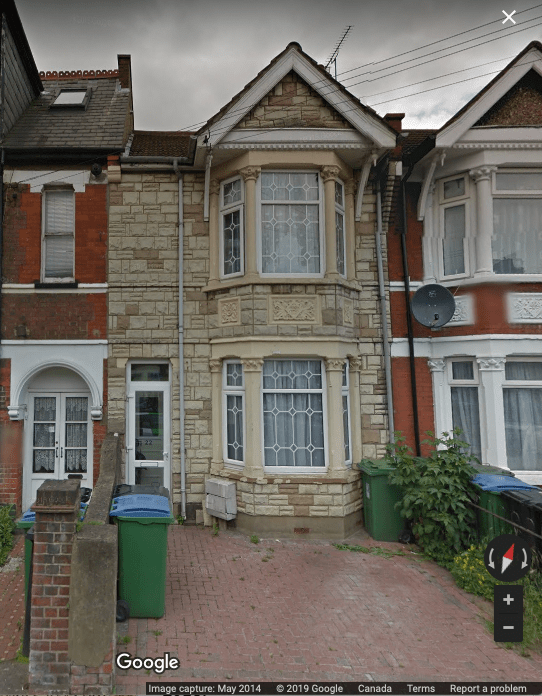
Below: 22 Whippendale Road, Watford, UK

One final note, my late father, Frank Ingold, did a family history in 2007 and he got a lot wrong, including his belief that 4 of the Ingold sisters, including Bertha visited the Puddifant family in Canada around 1920. There is absolutely no proof of that, no travel records exist on either side of the Atlantic, and particularly in Bertha’s case is logistically impossible. It’s a reminder that family memories can be sketchy and some need to be taken with a grain of salt…

Bertha Maud Ingold James b. Edgware UK 1871 d. Watford UK 1953

Tales From The Tree

We were told as kids that George Ingold went to prison for taking the fall for his boss in a shady deal that cheated the Canadian Army of meat supplies during WW1.  He apparently spent a year in Stoney Mountain Prison, Manitoba
I’m not really sure how the story got twisted, but it’s not entirely true.
I’ve learned from my family history research that you shouldn’t rely on any wild information your family gives you. Get the back up details.
I found the facts about George’s arrest and court case at Newspapers.com 
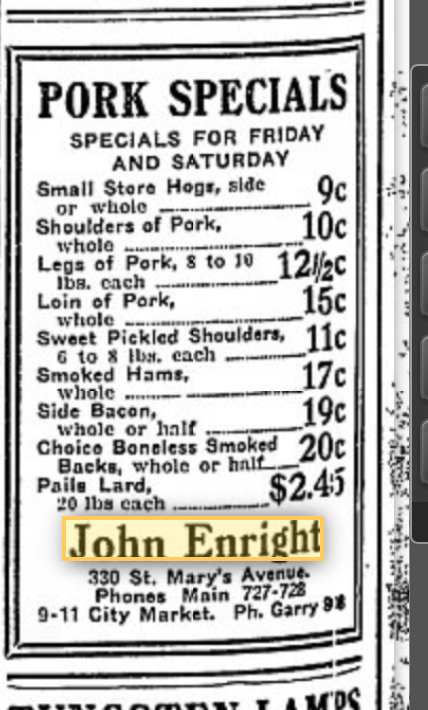
In 1916 George Ingold was 32 and unlike his brothers, didn’t volunteer for wartime duty and somehow avoided conscription. He was employed as a manager at one of John Enright’s two meat shops in Winnipeg.
 
Below: George’s entry from Henderson’s Winnipeg Directory, 1916
Like many food suppliers of the day, John Enright secured a government contract to supply meat to Canadian troops in Winnipeg. In late March of 1916 and after some investigation, evidence of a conspiracy was found. Enright’s government contract was cancelled and George Ingold was arrested and charged with fraud and bribery. 
Below: Winnipeg Tribune, May 16, 1916
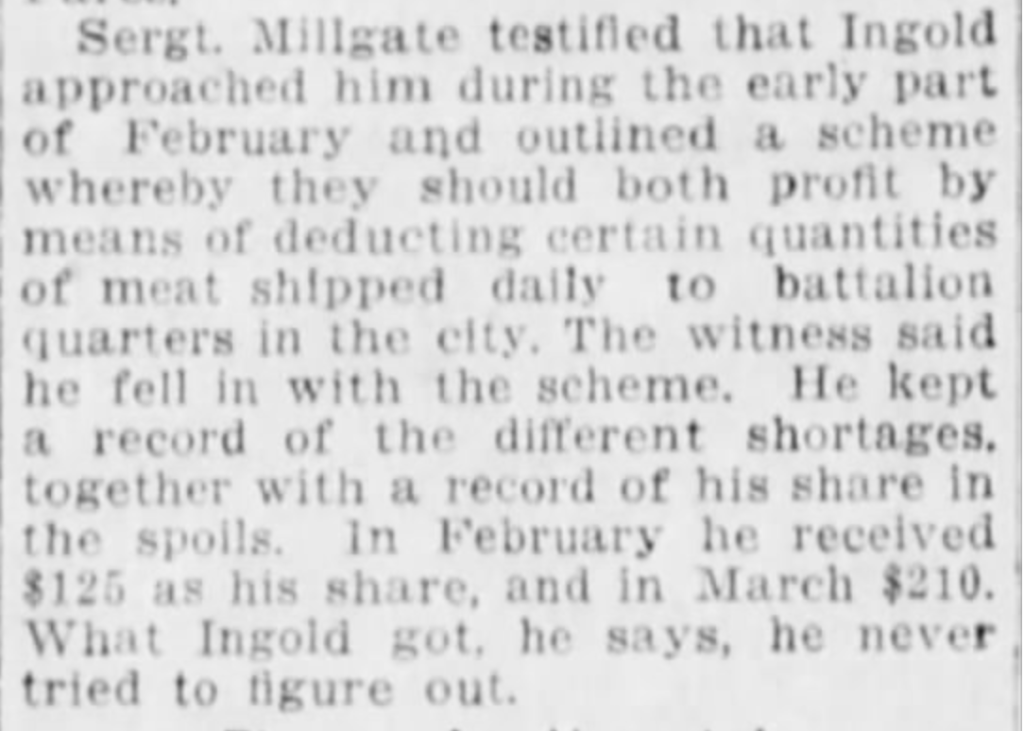
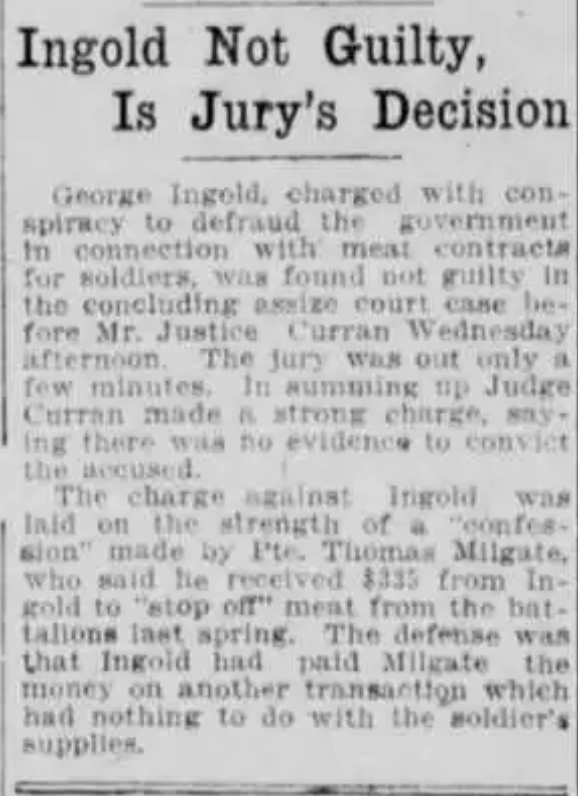
At the trial in November of 1916, Sergeant Milgate, George’s co-accused turned King’s evidence and testified for the Crown.
The jury didn’t accept Milgate’s testimony and acquitted George.
Whether or not George’s boss, John Enright had anything to do with this crime, we’ll never know. Enright must have been angry at the loss of a lucrative government contract.  It’s also telling that in the 1918 directory George is no longer a “manager”. He’s listed as a “meat cutter”.
Below: George’s entry from Henderson’s Winnipeg Directory, 1918
George died before we were born, but everything we heard about him indicates he was entirely capable of this type of larceny. He was obsessed with money schemes.  He likely saw an opportunity to profit from the war and jumped at it. His boss knew it too and demoted George to meat cutter.
George was lucky to be acquitted. At worst, he may have spent a couple of days in jail. He paid his own surety – $100.
 
Walter George Ingold, b.1884 Edgware, UK d.1954 Niagara Falls, CA

Tales From The Tree

Part One:

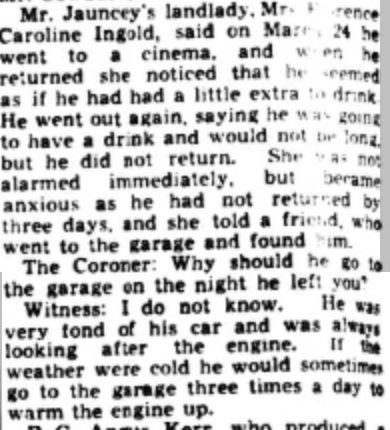
In April of 1937, Florence Caroline Ingold sat in the witness box at the inquest into the death of her “border”, 39 year old Reginald William Frank Jauncey. On the evening of March 24, 1937, Mr. Jauncey went out drinking and never returned. Mrs. Ingold reported him missing 3 days later and he was found in her garage at the wheel of his car, dead of carbon-monoxide poisoning. 
From The Norwood News, April 2, 1937 – BritishNewspaperArchive.com
Accidental death was the verdict, but I wonder if the Court or the Police were aware that Mr. Jauncey was a former lover of Mrs. Ingold and who was 22 years his senior? Would the law have looked a little closer into Florence? I would not be surprised if she had something to do with Mr. Jauncey’s death.
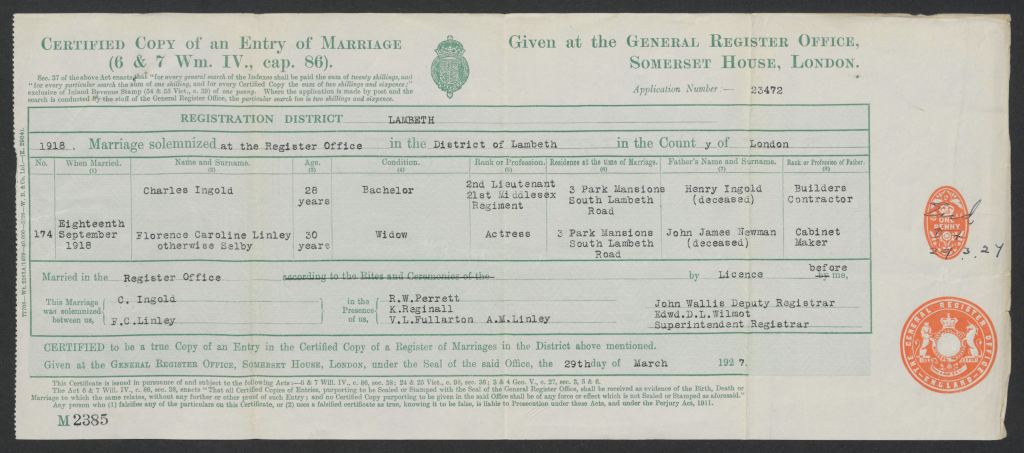
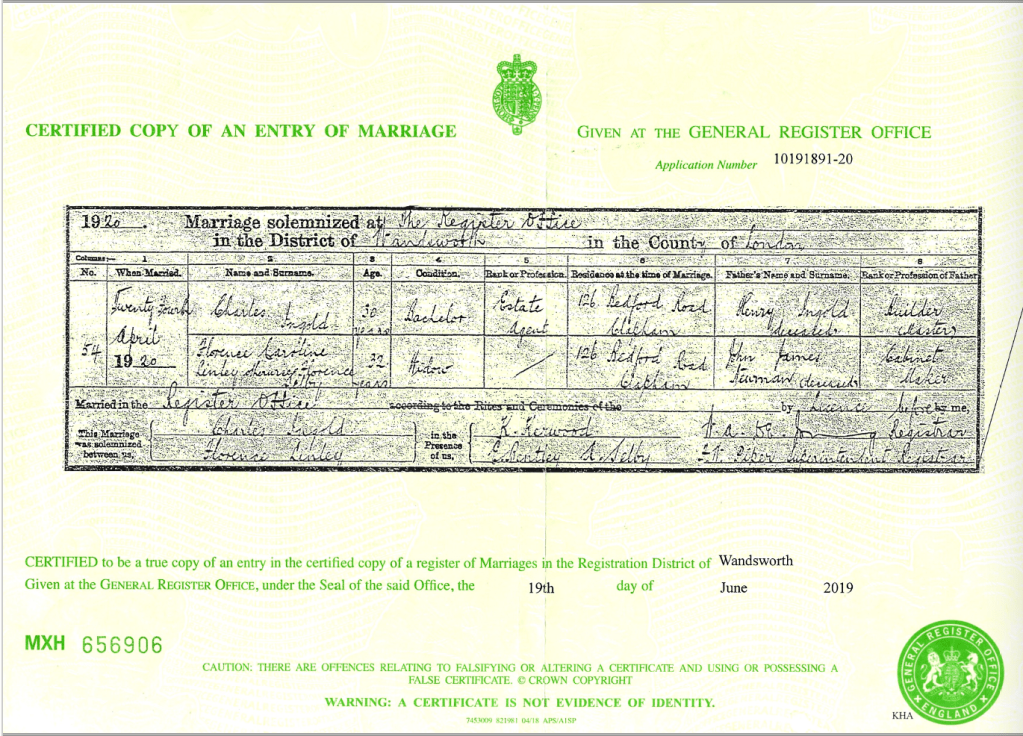
She was the legal wife of my father’s uncle Charley Ingold (1890-1968) and the widow of “lyric-writer” and “comedian” Albert Linley, the father of her young daughter, Audrey. She fancied herself an “actress” and used the stage name “Florence Selby”.  I could find only 2 references to her in the theatre columns of the time, but I also believe she was living with a stage actor named Arthur Selby at one point.
I like to believe Charley was a “Stage Door Johnny”:  on leave from Flanders in 1918, he takes in a few London theatricals and meets “actress” Florence Selby. The oddest thing about these two is that they married twice – once in 1918 and once in 1920.
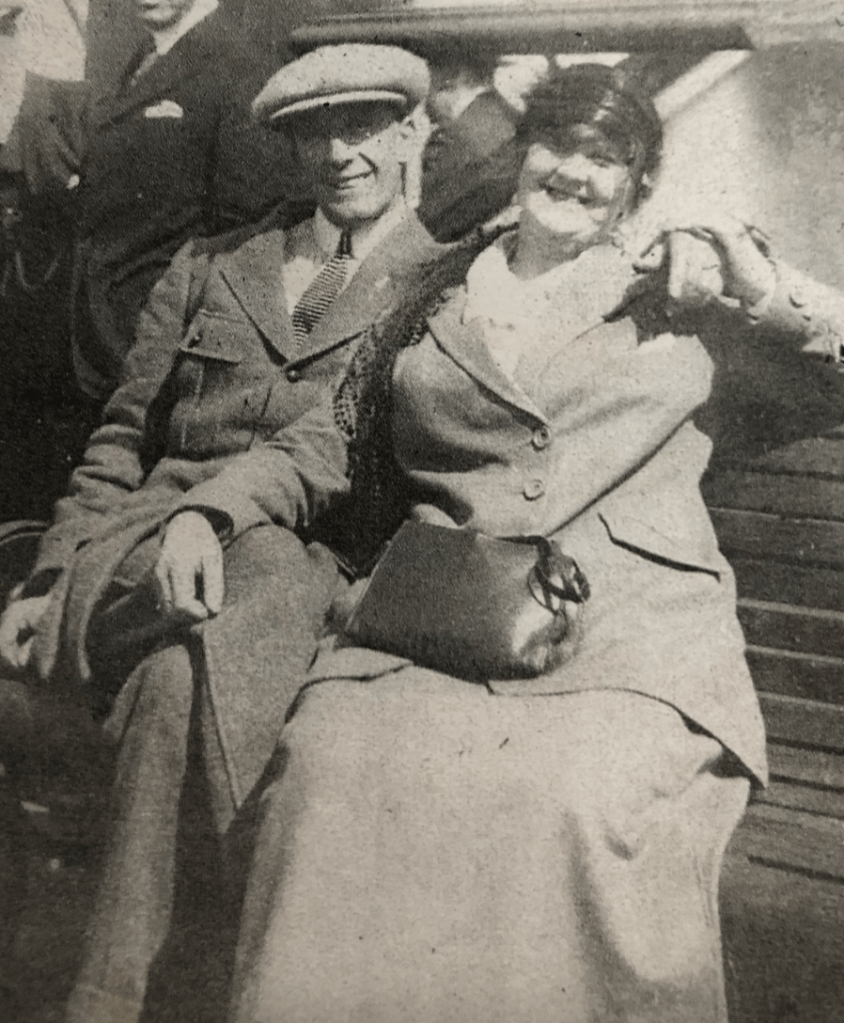
Photo: Charley and Florence on the “Victorian”, headed for Canada in June of 1920..
After the second marriage to Charley in 1920, they emigrated to Winnipeg. Charley worked as a confectioner and she at a grocery shop. I’m guessing she didn’t like working, so she left Charlie after a year and ran off to Australia with a man named Leslie Townsend. She also had an affair with Joe Higgins, who was on the same ship to Australia. After returning to England she took up with Reginald Jauncey, 22 years her junior, the same Reginald who would later die in her garage.
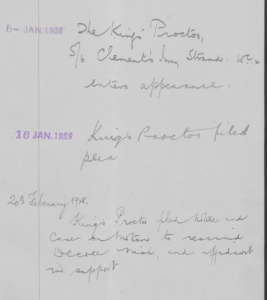
In 1927 Florence sued Charley for divorce on the grounds of adultery. Charley contested the divorce, producing convincing evidence of her above-mentioned lovers. The King’s Proctor refused to grant her a divorce. 
In the meantime, she opened up a night club in Streatham with a much younger man, Ernest Brown. Predictably, she named it “The Florence Club”…
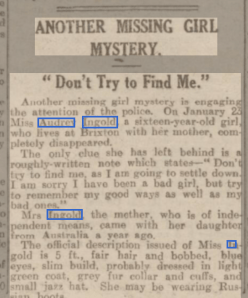
Florence had a knack for getting her name in the newspapers. Previous to her appearance at the inquest to Mr. Jauncey’s death, she reported the disappearance of her daughter in 1926. 
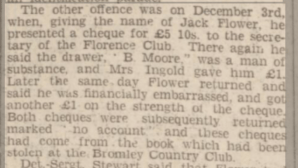
…and in June 1939, a Mr. Moore was charged with passing bad cheques to Florence and her “club”…
She was enumerated as living with Ernest Brown in the 1939 War Register.
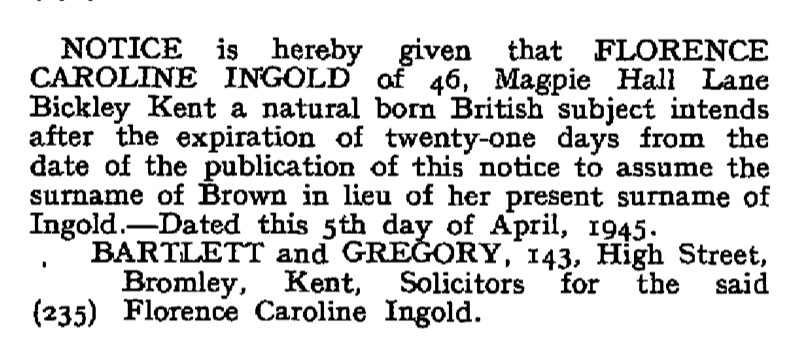
In 1945, obviously giving up on ever divorcing,  she put an ad in the London papers announcing she would be foregoing the surname “Ingold” and henceforth be known as “Florence Brown”.

To Be Continued…

I will be writing a 2nd post on Florence delving into her years in Australia, where she got her money, her “club” and whatever happened to her daughter Audrey…
 
Florence Caroline Newman Selby Linley Ingold Brown 1888-1968


Tales From The Tree

William Ingold and the 21 Turkeys

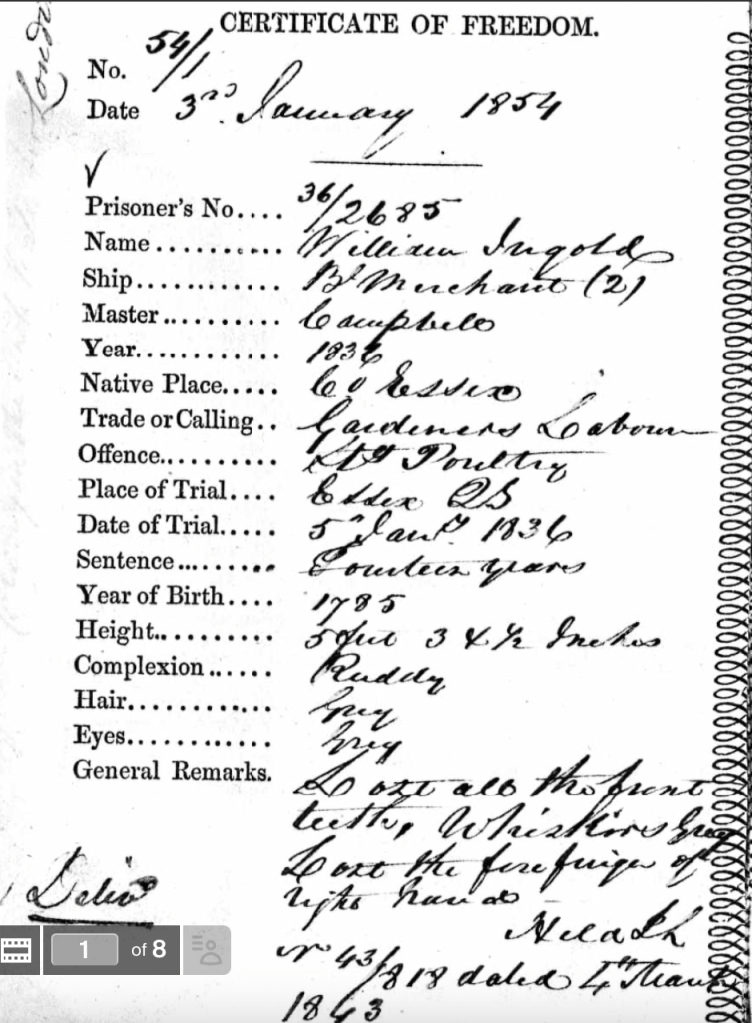
My 3rd Great-Grand Uncle, William Ingold (1785-1858) was transported from England to Australia in 1836 for taking possession of 21 stolen turkeys from a local farmer. He was one of several men involved in the crime. 

One of William’s descendants on Ancestry.com describes his crime as a “desperate act of a widowed man trying to feed his 9 children”.  I wondered if there were more to the story.

At BritishNewspaperArchive.com, I found a much more colourful story of William Ingold’s criminal past..

He didn’t actually steal the 21 turkeys – his accomplices did the thieving and William took possession of them with intent to sell. Trouble is, by the time he got them to market the turkeys had rotted. He was arrested and charged.

While William may indeed have been a widower with 9 children, he was also a habitual criminal. Not only did he confess to receiving the stolen turkeys, but he showed no remorse and offered a plea deal to give up his accomplices, save for his stepson, Henry Claydon. You have to admire a man who would hang rather than implicate his stepson.

“If I am promised no punishment and not obliged to name one of them (his son), I will make a further confession, but if not I will have a rope put around my neck and be hanged afore I will impeach one of them”

At trial it was revealed William had been a member of the notorious “Elsenham Gang”, who terrorized the locals with a series of violent night time burglaries in 1817. William Ingold escaped and fled while 3 of his accomplices were hanged for the crimes. 

Also, in 1825  William spent a month in jail for an “offence against game laws” (stealing).

Getting back to the case of the 21 Turkeys, William pleaded to the court he should not be jailed as he had not done the stealing. 

In the end, William’s plea fell on deaf ears and he was sentenced to 14 years of hard labour at Goulburn, Australia. In January of 1836 at age 51, he was placed aboard “The Bengal Merchant” with 270 other “criminals” bound for the penal colony at Goulburn, New South Wales. His stepson, Henry Claydon continued his thieving ways and was transported 2 years later

The Bengal Merchant

Below is a fascinating blog which gives some insight into the kind of hard prison life he experienced at Goulburn. A terrible punishment for thieving.

https://towrangstockade.com.au/convicts/

William Ingold earned his pardon after 14 years and returned to England in 1854. His pardon record describes him as 5’3″ with a ruddy complexion, grey eyes and hair. He had no front teeth and was missing the forefinger of his right hand.

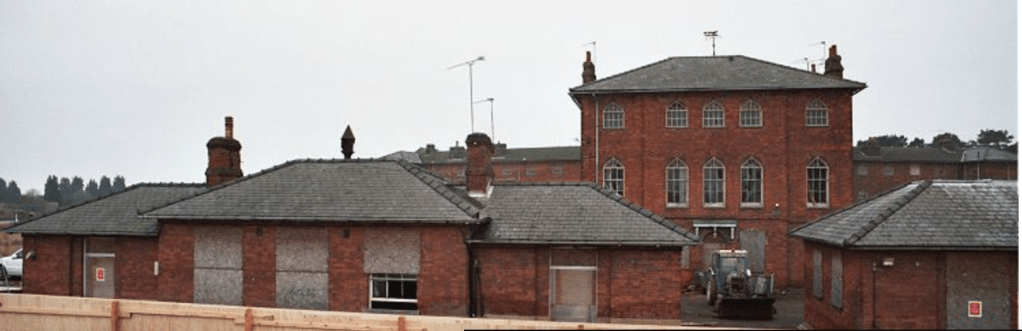
Four years after returning to England, William died in the Workhouse at Bishop’s Stortford in January, 1858. He was 73.

The Workhouse at Bishop’s Stortford

I’m looking forward to digging deeper into his life in Australia, and his return to England. I am also anxious to examine the criminal pasts of his stepson, Henry Claydon and his biological sons, Joshua and Jasper…

Henry John Ingold 1848-1895

A compelling account of his suicide, the inquest and the funeral from the Middlesex Courier, July 5, 1895

Edgware, The Death of Mr. Ingold

The Inquest:

On Friday last, Dr. V.G. Benson, deputy coroner for West Middlesex, held an inquest touching the death of Mr. Henry Ingold, whose death occurred under regrettable circumstances, (on June 26) as reported in our issue last week. Mr. J. Millard was chosen as foreman of the Jury.

The first witness called was Miss Bertha Ingold (PAM NOTE: George’s sister, age 23). She said her father was 47 years of age. Until lately he had enjoyed very good health, but for the last few weeks he had been unwell and seemed to be very depressed. There was nothing strange in his manner but he seemed to be labouring under a delusion that his business was not prosperous. On Wednesday last he left home about nine-o’clock and as he was not at home, she went to the office to see if he was there. Shen then found a letter there, which she now produced. The letter was not read in public, but handed it to the coroner who, after perusing it, said there was no need for the letter to be read. The deceased appeared to be suffering under a delusion about his business, which was incorrect. Miss Ingold, continuing her evidence, said that in consequence of statements made in the letter, a search was made for the deceased.

F.W. Hook, a carpenter of Burnt Oak, was the next witness. He said he saw the deceased at half past ten o’clock on Wednesday morning, going along the path leading to the reservoir. He seemed then to be in his normal health.

Charles Bishop said that he was one of those who helped to search for the deceased and he found the body in the pond known as “Doctor’s Pond”. Information was then given to the police. 

Sergeant Stewart deposed to recovering the body in the pond. The deceased’s coat was hanging on the hedge and on the brink of the pond was a bottle containing spirits of salt (PAM NOTE: hydrochloric acid). 

Dr. Findlater said that he last saw the deceased about two months ago, and at the time he showed no indications of mental trouble or anything that would lead one to consider that an act of this kind was contemplated. Of course, they knew that the deceased suffered from deafness. He had examined the body and from indications on the lips and in the mouth, the deceased had taken a portion of the spirits of salts.

PC Pridger said he searched the body and found on it two cheque-books and various papers.

Mr. Pritchard, who appeared on behalf of the friends, said that he had been through the business books and found them in a good state. The business was in a satisfactory condition and not as was supposed by the deceased.

This concluded, the evidence and after scarcely any consideration, the jury returned a verdict of “suicide, while of unsound mind”.

The Funeral

The funeral took place at Whitchurch on Tuesday afternoon, in the presence of almost the whole of the inhabitants of the village. Many from outlying villages assembled to bay their last respects to the departed friend. Most of the shops in Edgware and Little Stanmore were closed and the various tradesman followed their co-worker to the grave. The deceased was universally respected far and wide and not only in his own village, where the greater part of his life had been spent, but elsewhere where his business relations conducted always in a fair and honourable manner had won him many admirers. Coming as it did so suddenly and so quietly and totally unexpected, the terrible news startled and stunned the village, and it was long before it gained credence. But it was, alas – found to be true and universal regret was expressed and sympathy for the bereaved children.

If evidence were needed of the latter statement, one had only to have been present on Tuesday when his remains were consigned to the grave. The whole of the way from the house to the grave was marked with silent sympathy from the onlookers and at the graveside, there was a large concourse of people. Four carriages followed the hearse to the grave and in those were the relatives of the deceased. Among them were Mrs. Ingold, mother of the deceased. Mrs. Puddifant , Miss Bertha Ingold, Miss Hetty Ingold, Miss Maggie Ingold (PAM NOTE: George’s sisters, ages, 21, 23, 19, 17) and Master Harry Ingold (PAM NOTE: George’s brother, age 14), Mrs. Hale, sister of the deceased, Mr. G.Ingold, (uncle), Mr. Lawrence (cousin). Mr Hale, (brother in law), Mr. Brown (father-in-law), Mr. J. Puddifant (son-in-law) and Mrs. Hafhide, cousin.

Behind the carriages in reverent procession, followed the tradesmen of the village, among these were Messrs. Kersey, Ballard, Allpress, Bainbridge, Finsell, Wilby, Cheshire, Bart, Halsey, Palmer, Cribb, Francis, Johnson and Cardo. The solemn procession was met at the gates by Reverend J.B. Norman and at the service in the church, the organist, Mr. Edgington, played “O rest in the Lord” and “The Dead March” (Handel). The body was afterwards reverently consigned to the grave, the coffin being covered with wreaths.. Among the wreaths sent were tokens of respect from Mr. Coleman, Burnt Oak “with sympathy”, “With Mr.and Mrs. Allpress’s deepest sympathy”, “With sympathy from Aunt Evans”, “With Deepest Sympathy from Mr. and Mrs. E. Ballard”, “A Heartfelt Token from South Lodge, Edgware”, “To my dear son, with deepest regret from his sorrowing mother”, “With deep sympathy from Mr and Mrs. Thomas Puddifant”, “With Mr and Mrs. Thos. Drake’s sincere sympathy”, “With love and sympathy with all at Ware” “Mrs. Chas. Pritchard’s sympathy, Stone Grove Home, Edgware”, To our dear father from Jim and Edie”, “To our dear father from his sorrowing children”, With deep regrets for our dear brother from his sorrowing brother and sister, “With deepest sympathy from Bainbridge and Son”, “With deepest sympathy from his workmen”, With deepest regret and condolence from H. W. Lawrence, Lambeth”. 

The Misses Ingold wish to take this opportunity to thank all those who have so kindly sent expressions of sympathy by letters and otherwise.

PAM NOTE:  The younger siblings Lillian, 13, George, 11 (our grandfather), Frank, 8 and Charley, 5 did not attend the funeral.

PAM NOTE: The funeral selections played at Henry’s funeral are available on YouTube:

Tales From The Tree

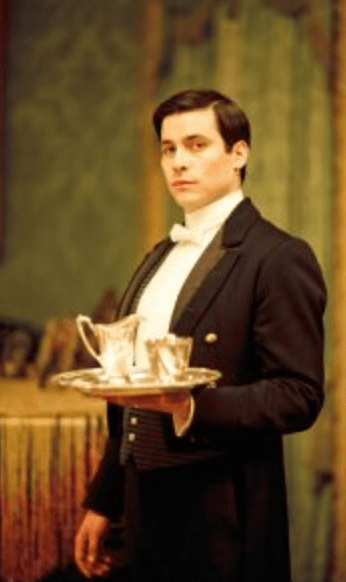
I love the idea of  having a “Mr. Carson” or Thomas Barrow” in my family, but we all know “Upstairs/Downstairs” and “Downton Abbey” are romanticized fiction. In reality, the lives of Victorian servants were hard. They had food and a roof over their heads, but worked long hours with little pay. The last thing they wanted was to make a career of cleaning out fireplaces at dawn, emptying chamber pots, scrubbing vegetables in the scullery or submit to the regimental hierarchy of servant life. Most wanted to take the skills they learned, get out and make their own way – and that’s exactly what my 2nd great grand uncles did.
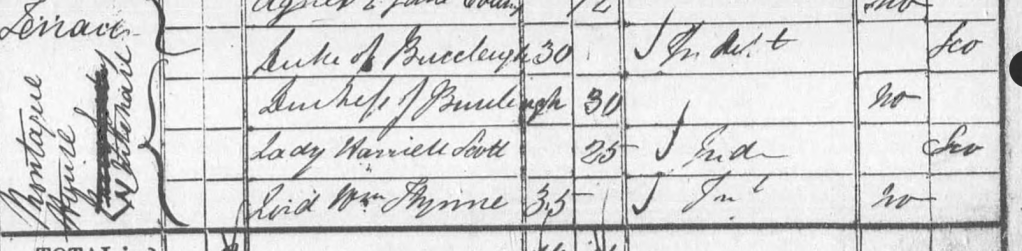
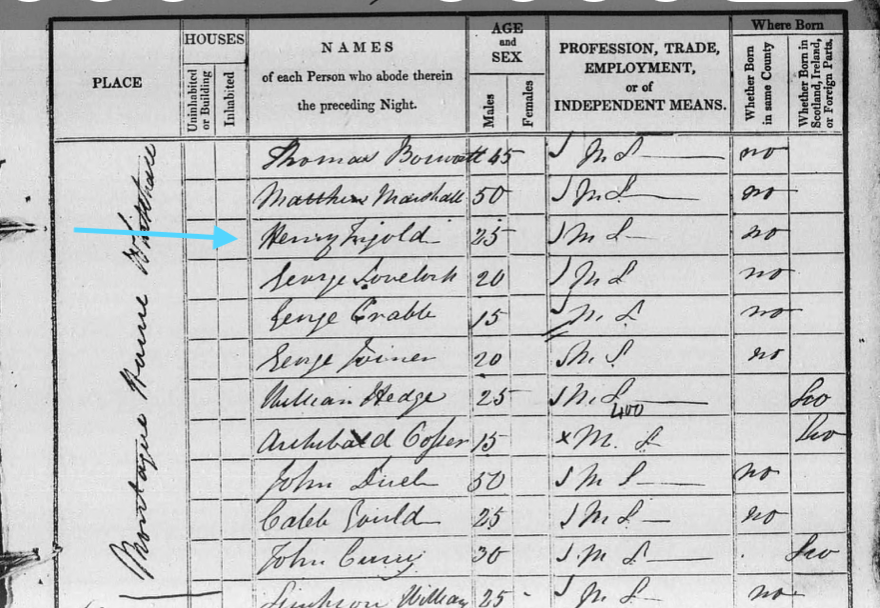
The 1841 Census finds 25 year old Henry as one of 37 servants in the household of the Duke and Duchess of Buccleuch, Lady Harriet Scott and Lord William Thynne at Montague House, Whitehall.  (37 servants!!!!)
Census entry for the Buccleuchs:
On the next 2 pages, their 37 servants. Henry Ingold is way down the hierarchy. I’m guessing he was a stableboy: 
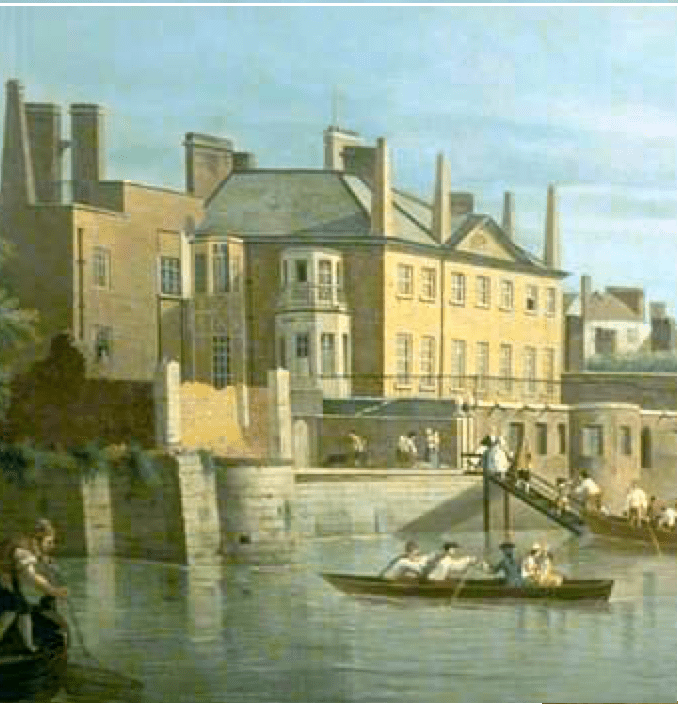
This is Montague House in Whitehall (painted in 1790), London Residence of the Duke and Duchess of Buccleuch (long demolished).
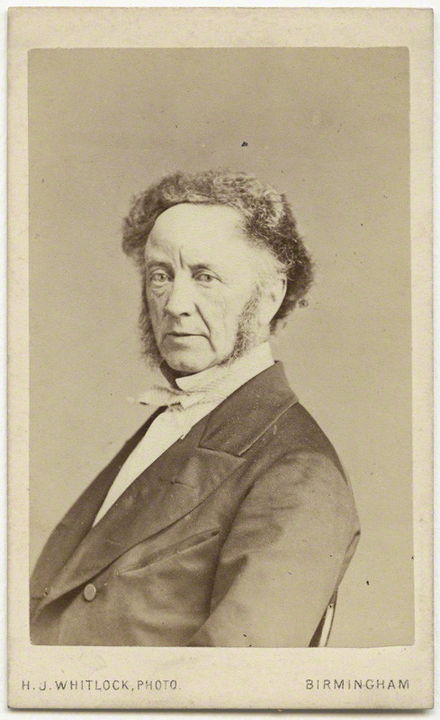
Finally, here are some notes on the Duke himself: 
His name was Walter Francis Montague Scott (1806-1884) and in addition to being the 5th Duke, he was a wealthy Scottish landowner, a Conservative politician in the government of Robert Peel, and a Knight of the Garter. 
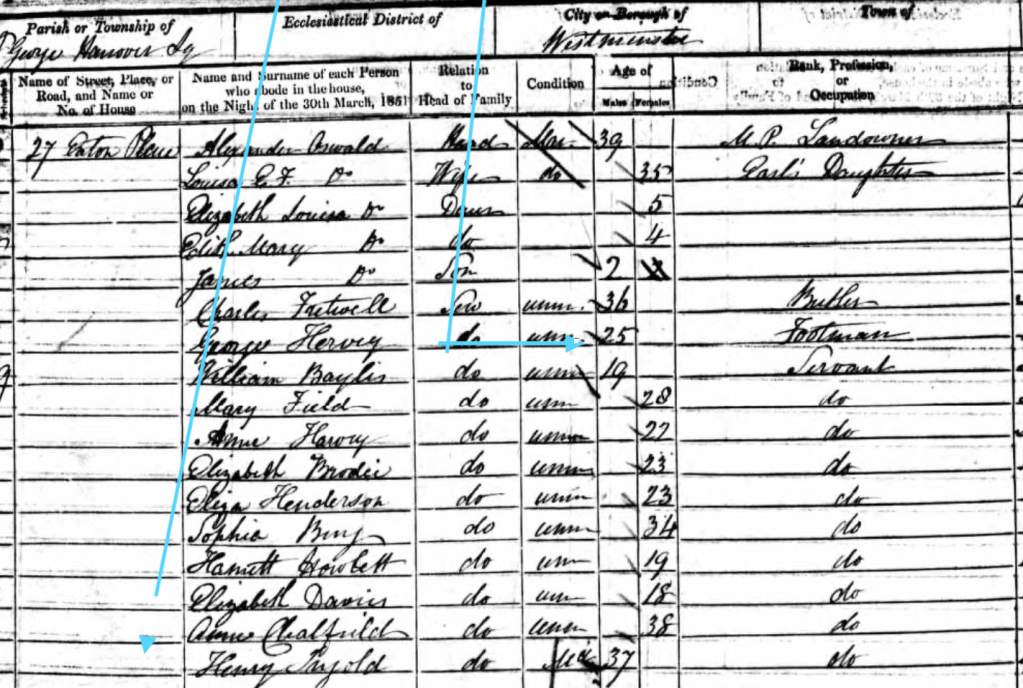
Ten years later in 1851, Henry Ingold, now in his late 30s, is in service to Alexander Oswald, Scottish Landowner and Conservative MP, his young family and 11 other servants at 27 Eaton Place.
Below, the 1851 Census entry. Note: Henry is at the bottom of the hierarchy. He’s likely a stable boy or groundskeeper.
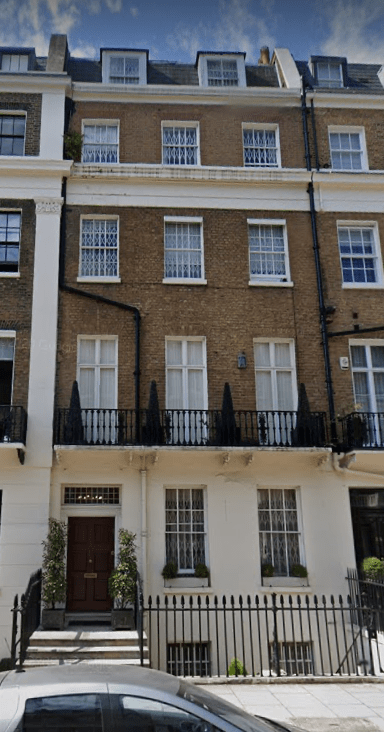
Below, 27 Eaton Place today. The servants generally lived in the attics and basements in these homes.
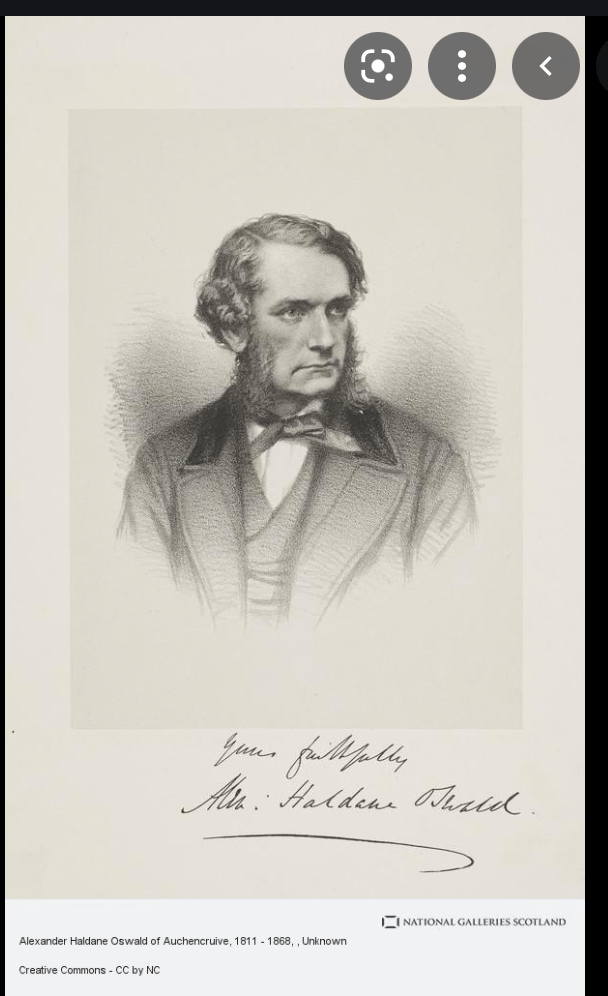
Here’s some information on Alexander Oswald, MP:
Alexander Haldane Oswald (1811-1868) was the Conservative MP for Ayershire, and a merchant who inherited considerable family property in Scotland.
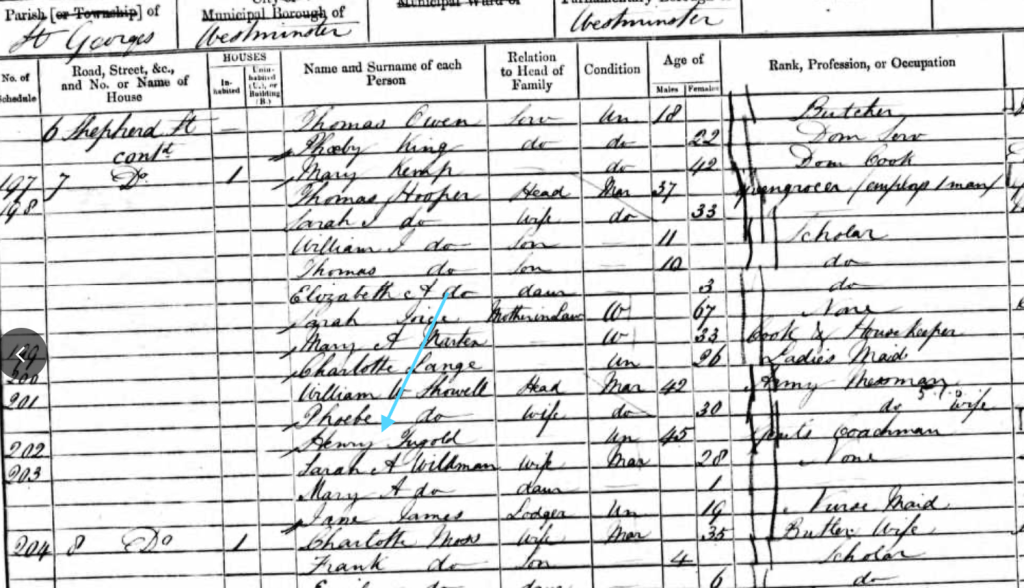
The 1861 census indicates that Henry now works as a “Gentleman’s Coachman”. Unfortunately we don’t know the name of his employer as he seems to be living in servant lodgings at 6 Shepherd Street, near Hanover Square. 
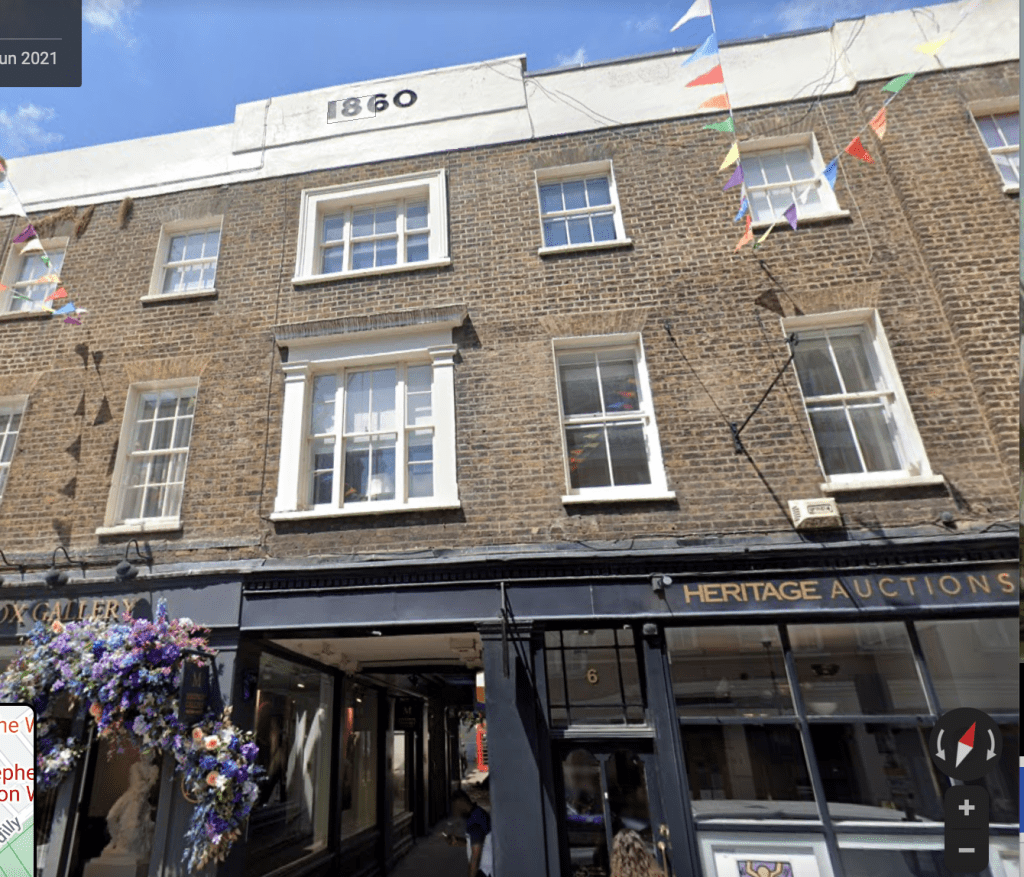
Below: 6 Shepherd Street, Hanover Square today. Note, the “1860” date stone. This would have been brand new housing for Henry!
Henry Ingold, left service and London’s privileged to return to Hertfordshire. The 1871 census shows with his brother in law in the brewery business. He never married, died in 1886 and left an estate of 1,300 pounds (about 172,000 today). Not bad for a stableboy.
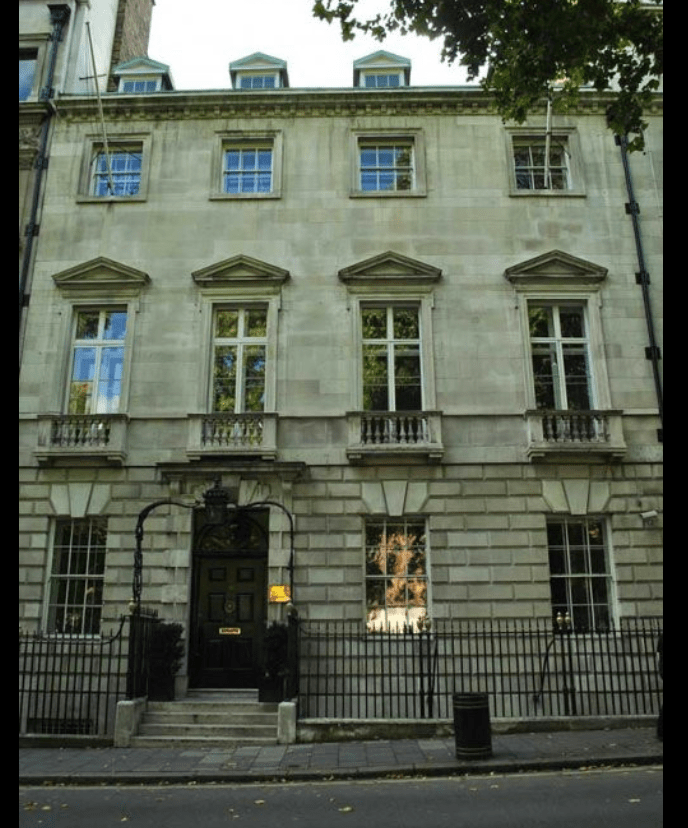
In 1851, George is 33 and a Footman in the household of Humphrey St. John Mildmay at 46 Berkeley Square. Mildmay was a Conservative MP and a partner in Baring’s Bank.  There are 13 other servants in the house.
This is 46 Berkeley Square today. It has been home to “Annabel’s”, a private club for the wealthy for over 50 years…
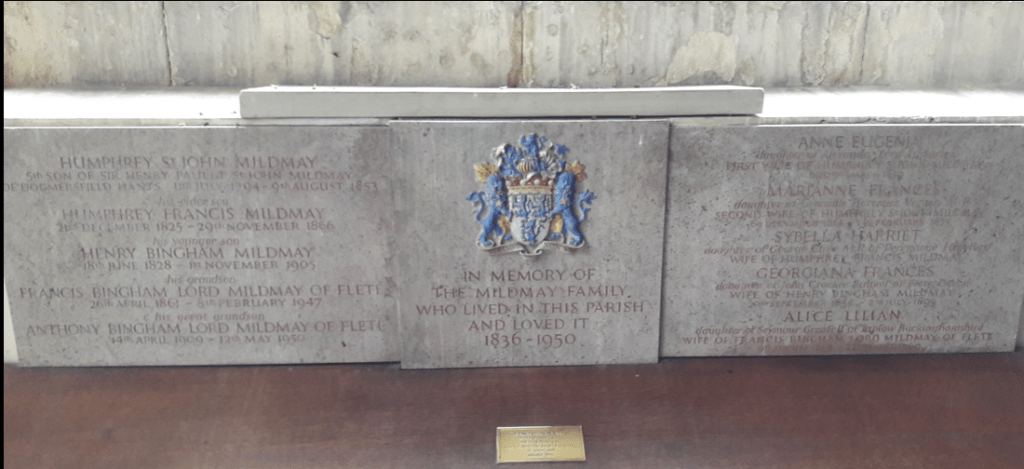
I could find no photos of Humphrey St. John Mildmay, but his family tomb is pretty impressive. Fact: Mildmay got his partnership in Baring’s Bank by marrying American heiress Anne Baring.
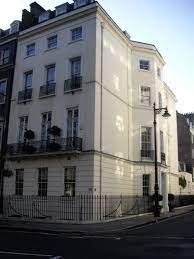
Ten years later, in 1861, George has moved down Berkeley Square to No. 42, the home of the impossibly-named John Cam Hobhouse aka “Baron Broughton” a man in his 70s. George is listed as “Valet” and there are 28 other servants.
42 Berkeley Square today. Today it houses luxury offices and a private club.
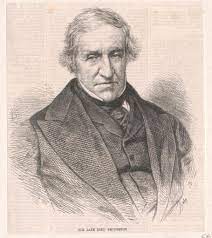
Here’s John Cam Hobhouse, Baron Broughton. Peer, Friend of Lord Byron, bon-vivant, non-conformist, world traveller, politician, witness to history – he had an incredible life. Read about him here. 
https://petercochran.files.wordpress.com/2009/12/00-introd

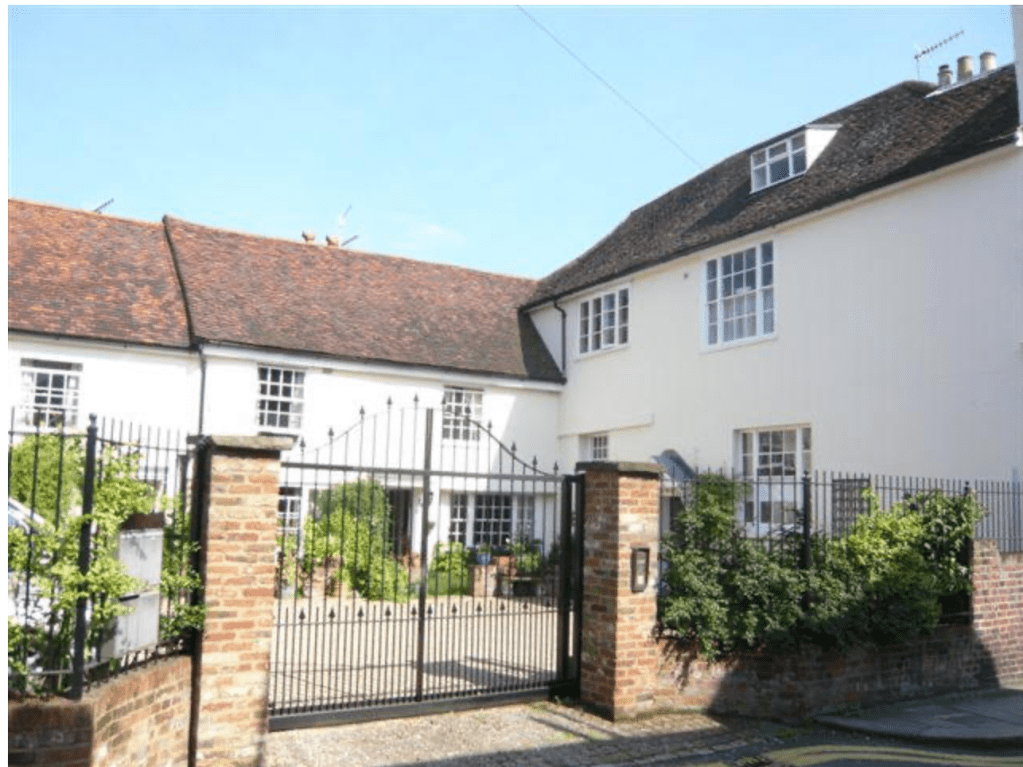
Like his brother, George Ingold left service and returned to his native Hertfordshire. In 1866 he acquired the license to operate “The French Horn” inn located in Ware. He operated the inn for the next 20 years, retiring at 68. I imagine his training as a gentleman’s valet was very helpful in the professional dealings of the business.
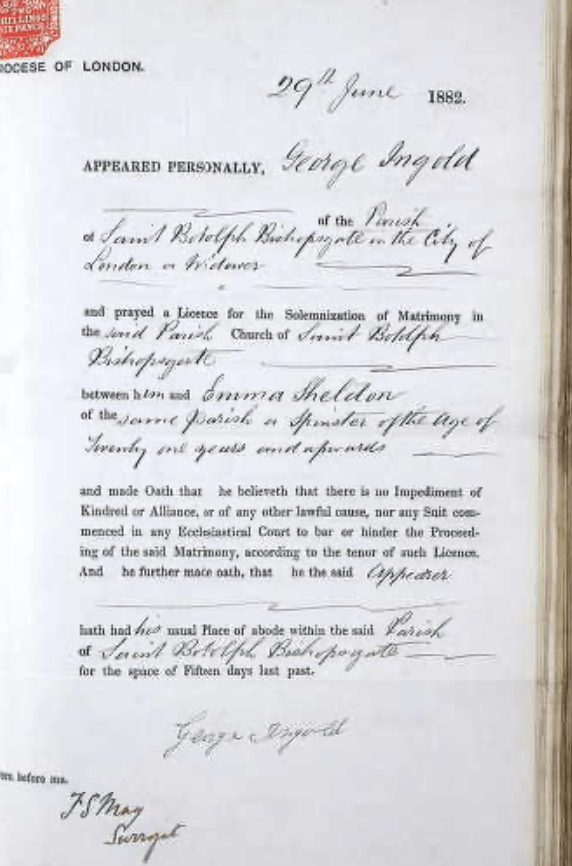
Fact: George married 2 sisters. He married Sarah Sheldon, a cook, in 1860. In 1882, he married her much younger sister, Emma. This was against the law at the time, but was commonplace among widowers. All they needed to do was spend 2 weeks in another parish.
“The French Horn” still exists today, as a private residence. 
George Ingold died in 1900, leaving an estate of 743 pounds sterling (about 92,000 pounds today).

52 Weeks of Ancestors – Week 1 – “Foundation”

The Foundation of Frugality in the Ingold family…

We’ve all heard it as children, and often as adults. A relative, perhaps a parent will remark “you’re just like your father”, or “you get that from your mother”, and even the ominous “I hope you don’t turn out like your grandfather”. 

We all have behaviours that pass down from our forebears. My family has a history of frugality.  I wanted to find which of my ancestors turned frugality into a science and passed it down for generations.

I have no photographs of my 19th century ancestors, but from my research, I recognize them very clearly. My siblings will agree with me when I say, what I discovered about our ancestors and money, explains a lot, and it is also a source of great amusement.

Let’s begin in my paternal ancestral home of Edgware, northwest of London, in the mid 19th century. My Great-Great Grandfather, James Ingold, worked as a carpenter and also held the lease on “The Mason’s Arms”, a local pub. James’s wife, Sarah, managed the pub with their youngest son, Alfred.

Upon his death in 1887, James Ingold left an estate of over $640,000 (2022 Canadian dollars). That is an astonishing legacy for a working class man in Victorian England.

James’s will reveals he was much more than a carpenter and publican. He was a landlord who owned at least 10 freehold properties in the Edgware area and collected rents on all of them. 

James’s paternal lineage includes butchers, millers and labourers, so just how did he manage to amass a portfolio of properties? I’ve got no documented information (yet), but I’m guessing James was a man driven to be “a big fish in a little pond”.  I believe he was a shrewd businessman who lived frugally and chased opportunity. I’ve seen these same traits in my immediate paternal family.

James had a wife who earned her own money, which was rare in the Victorian era. Although she didn’t need to work, Sarah managed the pub until 1891. After she died, James’s freeholds were auctioned off in 1900. Only a trip to England and a lot of in-person research is going to enlighten me as to exactly when and how James Ingold acquired so much property.

James’s will is very detailed and specific. It’s clear he was an astute businessman. Impressively, he set up his daughter Sophia and her children for a life financially independent of her well-to-do husband.
James’s eldest son, Henry John Ingold, (my great-grandfather) inherited the carpentry business and became a respected businessman, acquiring Edgware properties of his own. Thanks to newspaper reports, we know a lot about Henry’s frugality. Rather than invest in a new filly, he forced his lame horse to pull a heavy cart and was fined 6 shillings for cruelty to an animal. He was often cited for non-payment of fines imposed by the Sanitation Authority for failing to provide proper drainage at his properties. At parish meetings he protested higher taxes, and took on any civic responsibility that would earn him extra income.

Was Henry “cheap” or was just fiscally conservative? After all, he had 5 daughters to marry off. It was little bit of both, I think.

In June of 1895, Henry drowned himself in a pond, his suicide note claiming his business had failed. An inquest revealed that Henry’s business was in fact, thriving. Whatever his mental condition at the time, Henry believed a failing business was enough of a reason to off himself. When his estate was settled, each of his 9 children came into $15,000 (Can 2022). If Henry had lived, they would have inherited much more, but that’s a subject for another blog post.

As kids my father told us stories about Henry’s son, our paternal grandfather George (who died before I was  born). George arrived in Canada in 1905 with $15,000 Canadian in his pocket and a belief that the world was out to cheat him. He was extremely frugal and impressed upon his children the evils of lending and the importance of keeping money in the family. On the positive side, his work ethic was such that he was never out of a job, even during the Great Depression when he managed to keep his grocery business afloat. In that respect, George was much like James and Henry before him..

James Ingold (1810-1877) Carpenter, Licensed Victualler, Landlord

Henry John Ingold (1848-1895) Builder, Undertaker, Landlord

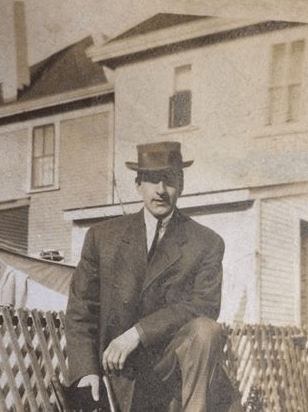
Walter George Ingold (1884-1954) Butcher, Grocer (pictured)